1 / 29
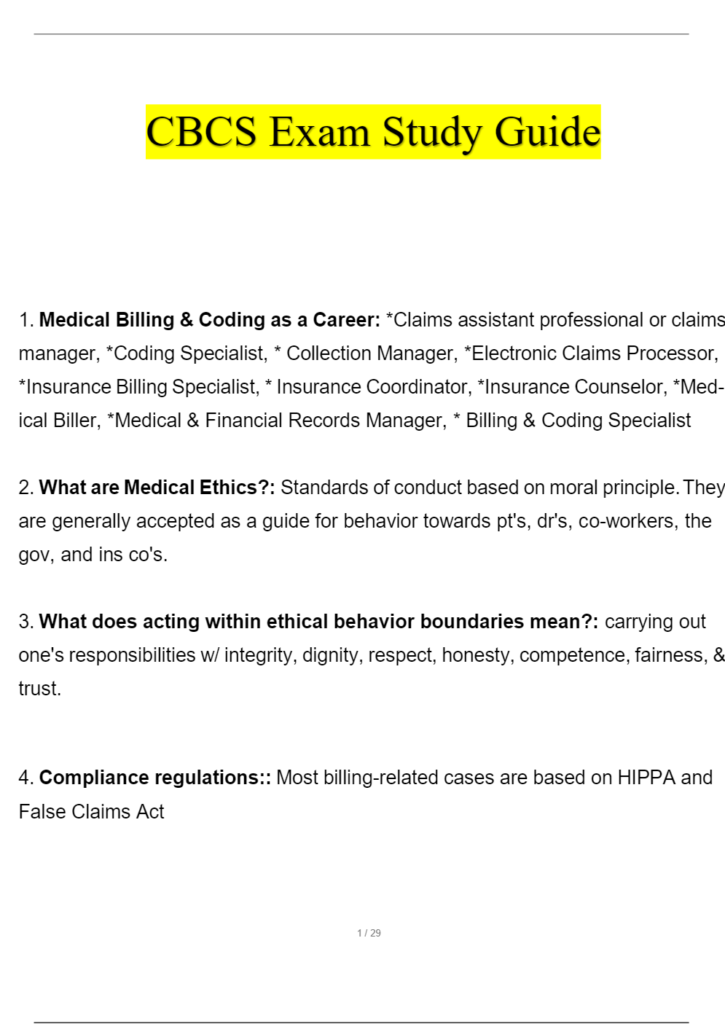
CBCS Exam Study Guide
- Medical Billing & Coding as a Career: *Claims assistant professional or claimsmanager, *Coding Specialist, * Collection Manager, *Electronic Claims Processor,
*Insurance Billing Specialist, * Insurance Coordinator, *Insurance Counselor, *Medical Biller, *Medical & Financial Records Manager, * Billing & Coding Specialist - What are Medical Ethics?: Standards of conduct based on moral principle.Theyare generally accepted as a guide for behavior towards pt’s, dr’s, co-workers, the
gov, and ins co’s. - What does acting within ethical behavior boundaries mean?: carrying out
one’s responsibilities w/ integrity, dignity, respect, honesty, competence, fairness, &trust. - Compliance regulations:: Most billing-related cases are based on HIPPA and
False Claims Act
2 / 29
- Health Insurance Portability & Accountability Act (HIPPA): Enacted in 1996,created by the Health Care Fraud & Abuse Control Program-enacted to check for
fraud and abuse in the Medicare/Medicaid Programs and private payers - What are the 2 provisions of HIPPA?: Title I: Insurance Reform
Title II: Administrative Simplification - What is Title I of HIPPA?: Insurance Reform-primary purpose is to provide continuous ins coverage for worker & their dependents when they change or lose jobsAlso *Limits the use of preexisting conditions exclusions *Prohibits discrimination
from past or present poor health *Guarantees certain employees/indv the right to
purchase new health ins coverage after losing job *Allows renewal of health ins covregardless of an indv’s health cond. that is covered under the particular policy. - What is Title II of HIPPA?: Administrative Simplification-goal is to focus on the
health care practice setting to reduce administrative cost & burdens. Has 2 parts- 1)development and implementation of standardized health-related financial & administrative activities electronically 2) Implementation of privacy & security proceduresto prevent the misuse of health info by ensuring confidentiality - What is the False Claims Act (FCA)?: Federal law that prohibits submitting a
fraudulent claim or making a false statement or representation in connection w/ a
claim. Also protects & rewards whistle-blowers.
3 / 29
- What is the National Correct Coding Initiative (NCCI)?: Developed by CMSto promote the national correct coding methodologies & to control improper codingthat lead to inappropriate payment of Part B health ins claims.
- How many edits does NCCI include?: 2: 1)Column 1/Column 2 (prev called
Comprehensive/Component) Edits
2) Mutually Exclusive Edits
4 / 29
- Column 1/Column 2 edits (NCCI): Identifies code pairs that should not be billedtogether b/c 1 code (Column 1) includes all the services described by another code(Column 2)
- Mutually Exclusive Edits (NCCI): ID’s code pairs that, for clinical reasons, areunlikely to be performed on the same pt on the same day
- What are the possible consequences of inaccurate coding and incorrect
billing?: *delayed processing & payment of claims *reduced payments, denied
claims *fine and/or imprisonment *exclusion from payer’s programs, loss of dr’s
license to practice med - Who has the task of investigate and prosecuting health care fraud &
abuse?: The Office of Inspector General (OIG) - Fraud: knowingly & intentionally deceiving or misrepresenting info that may
result in unauthorized benefits. It is a felony and can result in fines and/or prison. - Who audits claims?: State & federal agencies as well as private ins co’s
- What are common forms of fraud?: billing for services not furnished, unbundling, & misrepresenting diagnosis to justify payment