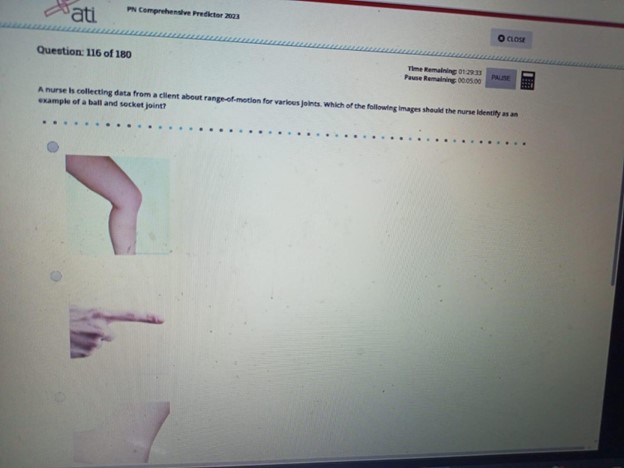
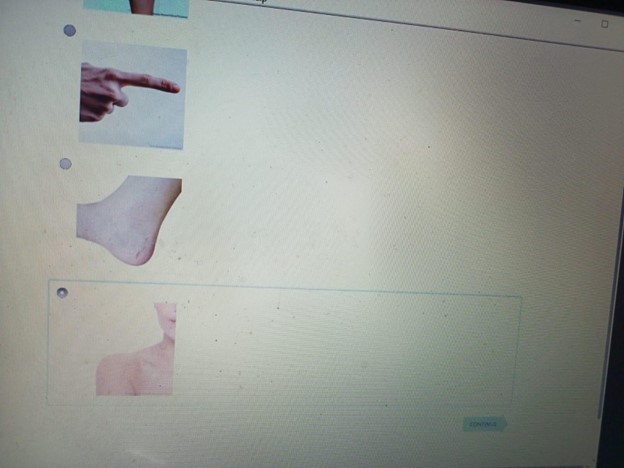
A nurse is collecting data from a client about a range of motion for various joints. Which of the following images should the nurse identify as an example of a ball an socket joint?
A.
Knee joint
B.
Interphalangeal joint
C.
Ankle joint
D.
Shoulder joint
The Correct answer and Explanation is:
The correct answer is D. Shoulder joint.
Explanation
A ball-and-socket joint is characterized by a spherical end of one bone (the ball) fitting into a cup-like cavity of another bone (the socket), allowing for a wide range of motion in multiple directions. The shoulder joint, specifically the glenohumeral joint, exemplifies this type of joint. It allows for flexion, extension, abduction, adduction, rotation, and circumduction, providing the arm with extensive mobility.
In contrast, the other options represent different types of joints:
- A. Knee joint: This is primarily a hinge joint, which allows movement mainly in one plane (flexion and extension). It does not permit the multi-directional movement characteristic of ball-and-socket joints.
- B. Interphalangeal joint: This joint, found in the fingers and toes, is also a hinge joint. It allows for flexion and extension, enabling the fingers to bend but limiting movement in other directions.
- C. Ankle joint: This is a modified hinge joint that permits dorsiflexion and plantarflexion. Although it allows for some side-to-side movement, it does not provide the full range of motion seen in a ball-and-socket joint.
Understanding joint types is crucial in nursing practice, especially when assessing a client’s range of motion. Identifying the shoulder joint as a ball-and-socket joint aids in evaluating mobility and function, as it highlights the potential for complex movements that may be affected by conditions such as arthritis, rotator cuff injuries, or other musculoskeletal disorders. The shoulder’s design enables not only the lifting of the arm but also reaching behind the back and above the head, making it essential for many daily activities. This knowledge assists nurses in planning effective interventions to maintain or restore joint function and overall mobility in clients.