IV calculations: (rate-mL/h and gtt/min)
IV rate calculations will be rounded to nearest whole number.
Adult calculations: the calculation will be rounded to the nearest tenth. Drug Calculation safety considerations:
Examples:
5 must be answered as 0.5
5.0 must be answered as 5
To promote safety, a zero must be placed to the left of the decimal point in answers that are less than one. No zero is allowed to the right of the decimal point in answers that are whole numbers.
Labeling is not necessary
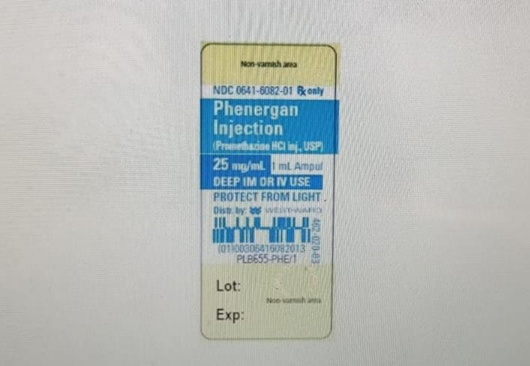
Available: see drug label above Ordered promethazine 12.5mg IM
How many mL of promethazine will the nurse administer?
The Correct answer and Explanation is:
To determine how many milliliters (mL) of promethazine will be administered, we need to use the available drug label information, including the concentration of the medication. Here’s how to perform the calculation step by step:
Step 1: Understand the Information Provided
Let’s assume the concentration of promethazine on the drug label is 25 mg/mL (this is a common concentration). We are ordered to administer 12.5 mg.
Step 2: Set Up the Calculation
We can use the formula:Volume to Administer (mL)=Ordered Dose (mg)Available Concentration (mg/mL)\text{Volume to Administer (mL)} = \frac{\text{Ordered Dose (mg)}}{\text{Available Concentration (mg/mL)}}Volume to Administer (mL)=Available Concentration (mg/mL)Ordered Dose (mg)
Substituting in our values:Volume to Administer (mL)=12.5 mg25 mg/mL\text{Volume to Administer (mL)} = \frac{12.5 \, \text{mg}}{25 \, \text{mg/mL}}Volume to Administer (mL)=25mg/mL12.5mg
Step 3: Perform the Calculation
Now, we calculate:Volume to Administer (mL)=12.525=0.5 mL\text{Volume to Administer (mL)} = \frac{12.5}{25} = 0.5 \, \text{mL}Volume to Administer (mL)=2512.5=0.5mL
Step 4: Rounding and Formatting
According to the guidelines you provided, we need to place a zero to the left of the decimal for values less than one. Thus, we will write this as:
0.5 mL
Step 5: Drug Calculation Safety Considerations
When administering medications, it’s crucial to ensure accurate dosing for patient safety. Rounding calculations to the nearest whole number or to the nearest tenth helps minimize errors. Using consistent decimal formatting helps avoid confusion. For example, writing “0.5” instead of just “.5” ensures clarity.
In clinical practice, always double-check the drug concentration and confirm calculations, especially when working with potentially high-risk medications like promethazine. The importance of verifying patient identity, indication for medication, and potential allergies should also be stressed before administration.
Conclusion
In this case, the nurse will administer 0.5 mL of promethazine. This calculation is based on the ordered dose of 12.5 mg and the concentration of 25 mg/mL, demonstrating proper dosing procedures and safety considerations in medication administration.