For each solute, identify the better solvent: water or carbon tetrachloride. Water, H2O Carbon tetrachloride, CCl4
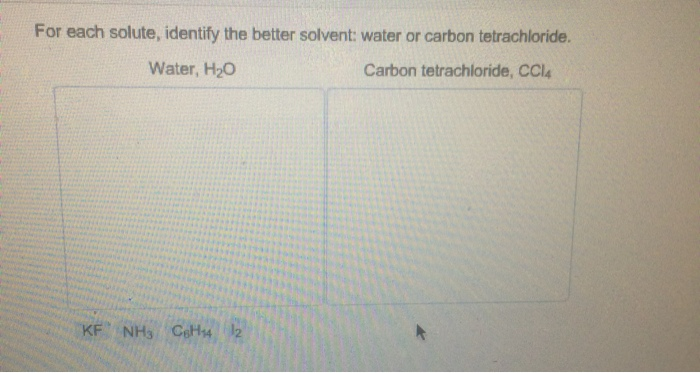
The correct answer and explanation is:
To identify whether water (H2O\text{H}_2\text{O}) or carbon tetrachloride (CCl4\text{CCl}_4) is a better solvent for a given solute, we must consider the principle of “like dissolves like.” This principle means polar solutes dissolve better in polar solvents, and nonpolar solutes dissolve better in nonpolar solvents. Here’s an analysis for common solutes:
- Ionic compounds (e.g., NaCl):
Better solvent: Water
Water is a polar molecule with a high dielectric constant, making it excellent for dissolving ionic compounds. The positive and negative ends of water molecules stabilize ions in solution, breaking ionic bonds in the solute. - Polar covalent compounds (e.g., ethanol):
Better solvent: Water
Polar covalent compounds form hydrogen bonds or dipole-dipole interactions with water, facilitating solubility. Ethanol, for instance, has an -OH group that interacts strongly with water. - Nonpolar molecules (e.g., I2):
Better solvent: Carbon tetrachloride
Nonpolar molecules are more soluble in nonpolar solvents like CCl4\text{CCl}_4 due to London dispersion forces. Water’s polarity cannot effectively interact with nonpolar solutes. - Oils and fats (nonpolar lipids):
Better solvent: Carbon tetrachloride
Oils and fats are nonpolar and thus dissolve readily in CCl4\text{CCl}_4, which matches their chemical nature. - Large polar organic molecules (e.g., glucose):
Better solvent: Water
Water interacts with multiple hydroxyl (-OH) groups on polar organic molecules like glucose, making it a superior solvent.
Explanation (300 words)
Water (H2O\text{H}_2\text{O}) and carbon tetrachloride (CCl4\text{CCl}_4) differ significantly in polarity. Water is polar due to its bent molecular geometry and electronegative oxygen atom. This polarity enables water to dissolve ionic and polar solutes through ion-dipole and hydrogen bonding interactions. In contrast, CCl4\text{CCl}_4 is nonpolar because its tetrahedral geometry cancels out the dipoles of its C-Cl bonds, making it effective for dissolving nonpolar solutes.
For ionic compounds like NaCl\text{NaCl}, water is superior because it reduces the lattice energy by stabilizing separated ions. Similarly, polar covalent molecules like ethanol dissolve in water through hydrogen bonding. However, nonpolar molecules such as I2\text{I}_2 or lipids are better dissolved in CCl4\text{CCl}_4, as they rely on dispersion forces that nonpolar CCl4\text{CCl}_4 provides.
Understanding solubility requires recognizing the intermolecular forces involved. Polar solvents like water interact through hydrogen bonding and dipole-dipole forces, while nonpolar solvents like CCl4\text{CCl}_4 rely on weaker dispersion forces. This dichotomy makes each solvent optimal for specific solutes, guided by the chemical principle of matching polarities.