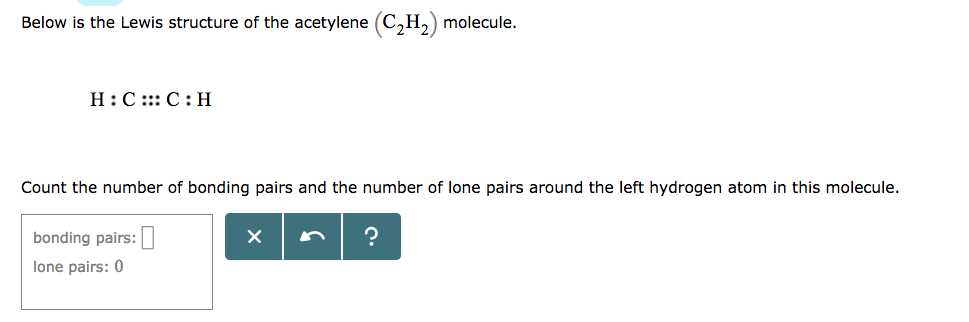
Below is the Lewis structure of the acetylene (C2H2) molecule H:C::: C:H Count the number of bonding pairs and the number of lone pairs around the left hydrogen atom in this molecule bonding pairs lone pairs: 0
The Correct Answer and Explanation is :
In the Lewis structure of acetylene (C₂H₂), the left hydrogen atom (H) is attached to a carbon atom (C). The molecule has the structure H-C≡C-H, with a triple bond between the two carbon atoms and single bonds between the carbon atoms and the hydrogen atoms.
Bonding Pairs and Lone Pairs:
- Bonding Pairs: A bonding pair refers to a pair of electrons shared between atoms, forming a chemical bond.
- The left hydrogen atom (H) in acetylene is bonded to the left carbon atom (C) with a single bond. A single bond involves one bonding pair of electrons.
- Lone Pairs: Lone pairs are pairs of electrons that are not involved in bonding and are localized around a single atom.
- The left hydrogen atom does not have any lone pairs. Hydrogen only requires two electrons in its valence shell to satisfy the octet rule, and since it is bonded to carbon via a single bond, it has fulfilled this requirement with its bonding pair.
Answer:
- Bonding pairs: 1
- Lone pairs: 0
Explanation:
- Acetylene Structure: The acetylene molecule consists of two carbon atoms, each bonded to a hydrogen atom. Between the carbon atoms, there is a triple bond (C≡C). In this structure, each carbon atom is sp hybridized, which means each forms two sigma bonds (one with hydrogen and one with the other carbon) and two pi bonds (within the triple bond between the carbon atoms).
- Electron Distribution: The electrons in acetylene are distributed such that the two hydrogen atoms each share a pair of electrons with a carbon atom. This allows each hydrogen atom to achieve a full valence shell (two electrons, satisfying the duet rule for hydrogen).
- Focus on Left Hydrogen: The left hydrogen in the acetylene molecule (H-C≡C-H) is involved in a single bond with its attached carbon atom. Hydrogen has only one electron to share, which pairs with one electron from the carbon to form a bonding pair. Since hydrogen doesn’t possess any non-bonding electrons, it has zero lone pairs.
Thus, the left hydrogen atom has 1 bonding pair and 0 lone pairs.