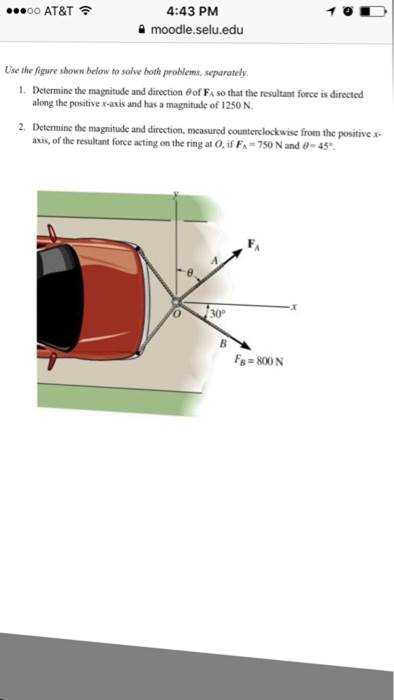
Determine the magnitude and direction ? of FASo that the resultant force is directed along the positive x-axis and has a magnitude of 1250 N. I. 2. Determine the magnitude and direction, measured counterclockwise from the axis, of the resultant force acting on the ring at O,if FA- 750 N and -4s positive x- FA 30° FB=800 N
The Correct Answer and Explanation is :
To solve these problems, we’ll decompose each force into its horizontal (x-axis) and vertical (y-axis) components, sum these components to find the resultant force, and then determine the required magnitudes and directions.
Problem 1: Determining the Magnitude and Direction of FAF_A
Given:
- Force FB=800 NF_B = 800 \, \text{N} at an angle of 30∘30^\circ from the positive x-axis.
- The resultant force FRF_R is directed along the positive x-axis with a magnitude of 1250 N1250 \, \text{N}.
We need to find the magnitude and direction θ\theta of FAF_A such that the resultant force meets these conditions.
Solution:
- Resolve FBF_B into components:
- FBx=FBcos(30∘)=800×cos(30∘)=800×32=800×0.866=692.8 NF_{Bx} = F_B \cos(30^\circ) = 800 \times \cos(30^\circ) = 800 \times \frac{\sqrt{3}}{2} = 800 \times 0.866 = 692.8 \, \text{N}
- FBy=FBsin(30∘)=800×sin(30∘)=800×0.5=400 NF_{By} = F_B \sin(30^\circ) = 800 \times \sin(30^\circ) = 800 \times 0.5 = 400 \, \text{N}
- Express the resultant force components:
- Since FRF_R is along the positive x-axis:
- FRx=1250 NF_{Rx} = 1250 \, \text{N}
- FRy=0 NF_{Ry} = 0 \, \text{N}
- Since FRF_R is along the positive x-axis:
- Set up equations for the components:
- In the x-direction:
- FAx+FBx=FRxF_{Ax} + F_{Bx} = F_{Rx}
- FAsin(θ)+692.8=1250F_A \sin(\theta) + 692.8 = 1250
- In the y-direction:
- FAy+FBy=FRyF_{Ay} + F_{By} = F_{Ry}
- FAcos(θ)−400=0F_A \cos(\theta) – 400 = 0
- In the x-direction:
- Solve for FAF_A and θ\theta:
- From the y-component equation:
- FAcos(θ)=400F_A \cos(\theta) = 400
- FA=400cos(θ)F_A = \frac{400}{\cos(\theta)}
- Substitute FAF_A into the x-component equation:
- 400sin(θ)cos(θ)+692.8=1250\frac{400 \sin(\theta)}{\cos(\theta)} + 692.8 = 1250
- 400tan(θ)+692.8=1250400 \tan(\theta) + 692.8 = 1250
- 400tan(θ)=557.2400 \tan(\theta) = 557.2
- tan(θ)=557.2400=1.393\tan(\theta) = \frac{557.2}{400} = 1.393
- θ=tan−1(1.393)≈54.3∘\theta = \tan^{-1}(1.393) \approx 54.3^\circ
- Now, calculate FAF_A:
- FA=400cos(54.3∘)=4000.584≈685.8 NF_A = \frac{400}{\cos(54.3^\circ)} = \frac{400}{0.584} \approx 685.8 \, \text{N}
- From the y-component equation:
Answer:
- Magnitude of FAF_A: 686 N686 \, \text{N}
- Direction of FAF_A: 54.3∘54.3^\circ from the positive x-axis
Problem 2: Determining the Resultant Force with Given FAF_A
Given:
- FA=750 NF_A = 750 \, \text{N} at 45∘45^\circ from the positive x-axis.
- FB=800 NF_B = 800 \, \text{N} at 30∘30^\circ from the positive x-axis.
We need to find the magnitude and direction of the resultant force acting on the ring at O, measured counterclockwise from the positive x-axis.
Solution:
- Resolve FAF_A into components:
- FAx=FAcos(45∘)=750×cos(45∘)=750×0.707=530.3 NF_{Ax} = F_A \cos(45^\circ) = 750 \times \cos(45^\circ) = 750 \times 0.707 = 530.3 \, \text{N}
- FAy=FAsin(45∘)=750×sin(45∘)=750×0.707=530.3 NF_{Ay} = F_A \sin(45^\circ) = 750 \times \sin(45^\circ) = 750 \times 0.707 = 530.3 \, \text{N}
- Resolve FBF_B into components:
- FBx=FBcos(30∘)=800×cos(30∘)=800×0.866=692.8 NF_{Bx} = F_B \cos(30^\circ) = 800 \times \cos(30^\circ) = 800 \times 0.866 = 692.8 \, \text{N}
- FBy=FBsin(30∘)=800×sin(30∘)=800×0.5=400 NF_{By} = F_B \sin(30^\circ) = 800 \times \sin(30^\circ) = 800 \times 0.5 = 400 \, \text{N}
- Sum the components to find the resultant force:
- FRx=FAx+FBx=530.3+692.8=1223.1 NF_{Rx} = F_{Ax} + F_{Bx} = 530.3 + 692.8 = 1223.1 \, \text{N}
- FRy=FAy−FBy=530.3−400=130.3 NF_{Ry} = F_{Ay} – F_{By} = 530.3 – 400 = 130.3 \, \text{N}
- Calculate the magnitude of the resultant force:
- FR=FRx2+FRy2=1223.12+130.32≈1230 NF_R = \sqrt{F_{Rx}^2 + F_{Ry}^2} = \sqrt{1223.1^2 + 130.3^2} \approx 1230 \, \text{N}
- Determine the direction of the resultant force:
- θ=tan−1(FRyFRx)=tan−1(130.31223.1)≈6.08∘\theta = \tan^{-1}\left(\frac{F_{Ry}}{F_{Rx}}\right) = \tan^{-1}\left(\frac{130.3}{1223.1}\right) \approx 6.08^\circ
Answer:
- Magnitude of the resultant force: 1230 N1230 \, \text{N}
- Direction: ( 6.08^\circ