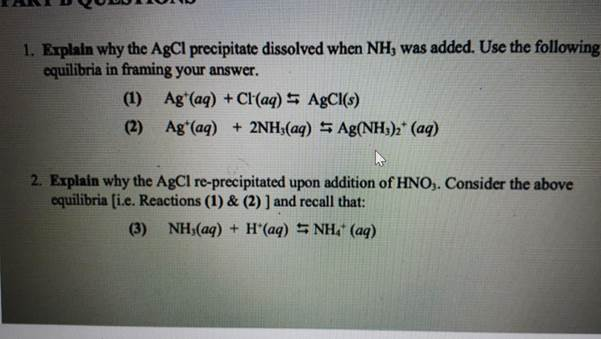
Explain why the AgCl precipitate dissolved when NHz was added. Use the following equilibria in framing your answer. (1) Ag+ (aq) + Cl(aq) = AgCl(s) (2) Ag(aq) + 2NH3(aq) 5 Ag(NH3)2+ (aq) 2. Explain why the AgCl re-precipitated upon addition of HNO3. Consider the above equilibria [i.e. Reactions (1) & (2) ] and recall that: (3) NH3(aq) + H(aq) = NH.+ (aq)
The Correct Answer and Explanation is :
Explanation of the Dissolution and Re-precipitation of AgCl:
- Dissolution of AgCl when NH₃ is added:
The dissolution of AgCl occurs because of the complexation of Ag⁺ ions with ammonia (NH₃). Let’s look at the chemical reactions involved:
- Reaction (1):
[ \text{Ag}^+(aq) + \text{Cl}^-(aq) \rightleftharpoons \text{AgCl(s)} ]
In this equilibrium, silver chloride (AgCl) is formed from its ions in the solution. When NH₃ is added, it reacts with Ag⁺ ions, forming a complex ion, (\text{Ag(NH₃)_2}^+), as shown in Reaction (2). - Reaction (2):
[ \text{Ag}^+(aq) + 2\text{NH₃}(aq) \rightleftharpoons \text{Ag(NH₃)_2}^+(aq) ]
The addition of ammonia shifts this equilibrium to the right, increasing the concentration of (\text{Ag(NH₃)_2}^+) in solution and decreasing the concentration of free Ag⁺ ions.
According to Le Chatelier’s Principle, as the concentration of Ag⁺ ions decreases due to their complexation with NH₃, the equilibrium of Reaction (1) shifts to the right to counteract this decrease, leading to the dissolution of solid AgCl. Therefore, the AgCl precipitate dissolves in the presence of ammonia due to the formation of the soluble (\text{Ag(NH₃)_2}^+) complex.
- Re-precipitation of AgCl upon the addition of HNO₃:
When HNO₃ is added, it introduces H⁺ ions into the solution. These H⁺ ions can react with the ammonia in solution as shown in Reaction (3):
- Reaction (3):
[ \text{NH₃}(aq) + \text{H}^+(aq) \rightleftharpoons \text{NH₄}^+(aq) ]
The added H⁺ ions protonate the ammonia molecules, converting them into ammonium ions (NH₄⁺). This reduces the concentration of free NH₃ in the solution, shifting the equilibrium in Reaction (2) to the left. As a result, the (\text{Ag(NH₃)_2}^+) complex breaks down, and Ag⁺ ions are released back into the solution. - Re-establishment of Reaction (1):
As the concentration of Ag⁺ ions increases, the equilibrium of Reaction (1) shifts to the left, causing AgCl to precipitate again from the solution. Thus, the re-precipitation of AgCl occurs because the free Ag⁺ ions, now present in higher concentration due to the breakdown of the complex, combine with the chloride ions to form solid AgCl.
In summary:
- NH₃ causes Ag⁺ ions to form a soluble complex, leading to the dissolution of AgCl.
- HNO₃ introduces H⁺, which reduces the availability of NH₃, causing Ag⁺ to be released and leading to the re-precipitation of AgCl.