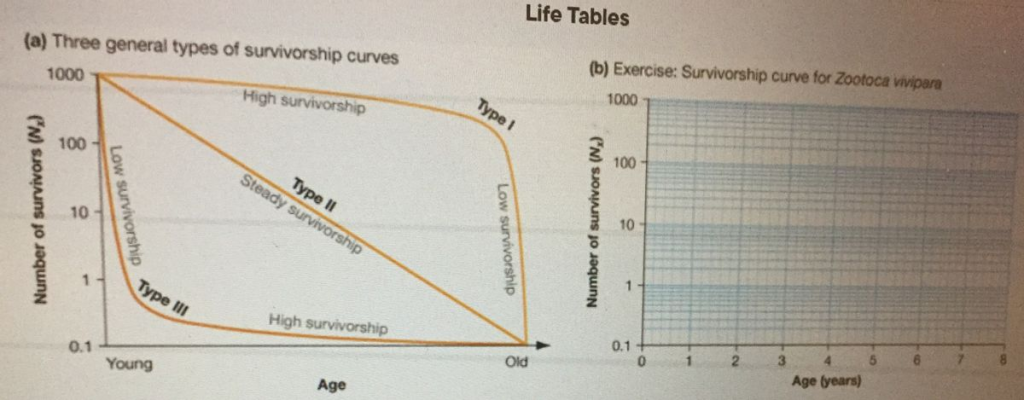
Three types of survivorship curve in your textbook (Fig 3). Which of the survivorship curves is/are associated with organisms that have their highest mortality rates in the early stages of life? None
The Correct Answer and Explanation is :
The survivorship curves describe patterns of survival across the lifespan of a species. There are three primary types:
- Type I Survivorship Curve: This curve is characterized by high survival rates throughout most of the life span, with mortality increasing significantly in older age. Humans and large mammals often exhibit this pattern, with most individuals living to old age.
- Type II Survivorship Curve: This curve shows a relatively constant mortality rate throughout all stages of life. The probability of dying is roughly the same at any age. Many bird species and some reptiles exhibit this type of survivorship, where death can happen at any time but is not significantly tied to age.
- Type III Survivorship Curve: This curve represents species that experience high mortality rates early in life but, once past a certain developmental stage, have a much higher chance of survival. Organisms like many fish, amphibians, and invertebrates follow this pattern, where a large number of offspring are produced, but only a few survive to maturity.
Correct Answer: Type III Survivorship Curve
In the case of the Type III curve, the organisms that follow it typically have the highest mortality rates in the early stages of life. This pattern is a result of producing a large number of offspring with the expectation that only a few will survive to adulthood. For example, species like many fish, insects, and plants, such as trees that produce thousands of seeds, often fit this model. The strategy behind this high initial mortality is that the reproductive output is so large that even with high early mortality, enough offspring survive to ensure the species continues.
The high early mortality could be due to various factors like predation, environmental conditions, or lack of parental care. These species often rely on quantity rather than quality in terms of offspring, hoping that the sheer number will guarantee enough individuals survive to reproduce.