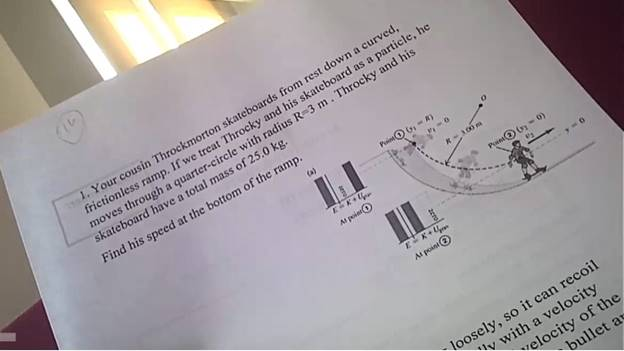
Your cousin Throckmorton skateboards from rest down a curved, frictionless ramp. If we treat Throcky and his skateboard as a moves through a quarter-circle with radius R-3 m . Throcky and his skateboard have a total mass of 25.0 kg. particle, he Find his speed at the bottom of the ramp. (a) PointO (y R) R3.00 m EK+Uce At poin Poini ( -0) y 0 EK+U At point (2) loosely, so it can recoil y with a velocity velocity of the bullet a
The Correct Answer and Explanation is :
To find Throckmorton’s speed at the bottom of the ramp, we can apply the principle of conservation of mechanical energy. The total mechanical energy at any point during Throckmorton’s motion remains constant (assuming no energy is lost to friction or other forces). The mechanical energy of a system is the sum of kinetic energy (K.E.) and potential energy (P.E.):
[
E_{\text{total}} = K.E. + P.E.
]
Step 1: Energy at the top of the ramp (Point O)
At the top of the ramp, Throcky is at rest, so his initial kinetic energy is 0. The only form of energy he has is gravitational potential energy, which is given by:
[
P.E_{\text{top}} = mgh
]
where:
- ( m = 25.0 \, \text{kg} ) (mass of Throcky and his skateboard),
- ( g = 9.8 \, \text{m/s}^2 ) (acceleration due to gravity),
- ( h = R = 3.00 \, \text{m} ) (height of the ramp, which is the same as the radius of the circular arc).
Thus, the potential energy at the top is:
[
P.E_{\text{top}} = (25.0 \, \text{kg})(9.8 \, \text{m/s}^2)(3.00 \, \text{m}) = 735 \, \text{J}.
]
Step 2: Energy at the bottom of the ramp (Point P)
At the bottom of the ramp, Throcky is at the lowest point, and thus the height is zero, so his potential energy is zero. All of his initial potential energy has been converted into kinetic energy. Therefore, at the bottom of the ramp, the kinetic energy is equal to the initial potential energy:
[
K.E_{\text{bottom}} = P.E_{\text{top}} = 735 \, \text{J}.
]
Step 3: Solve for speed at the bottom
The kinetic energy is given by the formula:
[
K.E = \frac{1}{2}mv^2
]
where ( v ) is the speed of Throcky at the bottom of the ramp. We can set the kinetic energy equal to the value we found earlier and solve for ( v ):
[
735 \, \text{J} = \frac{1}{2}(25.0 \, \text{kg})v^2
]
Multiplying both sides by 2:
[
1470 \, \text{J} = (25.0 \, \text{kg})v^2
]
Now, solve for ( v^2 ):
[
v^2 = \frac{1470 \, \text{J}}{25.0 \, \text{kg}} = 58.8 \, \text{m}^2/\text{s}^2
]
Finally, take the square root of both sides to find ( v ):
[
v = \sqrt{58.8} = 7.67 \, \text{m/s}.
]
Conclusion
Throckmorton’s speed at the bottom of the ramp is approximately ( 7.67 \, \text{m/s} ).
Explanation
The energy at the top of the ramp was entirely potential energy due to the height of the ramp. As Throcky descends, this potential energy is converted into kinetic energy. By applying the conservation of mechanical energy and solving for the velocity at the bottom, we find that Throcky’s speed increases as the potential energy is converted to kinetic energy.