THERMODYNAMICS: ENTHALPY OF FORMATION- MAGNESIUM OXIDE
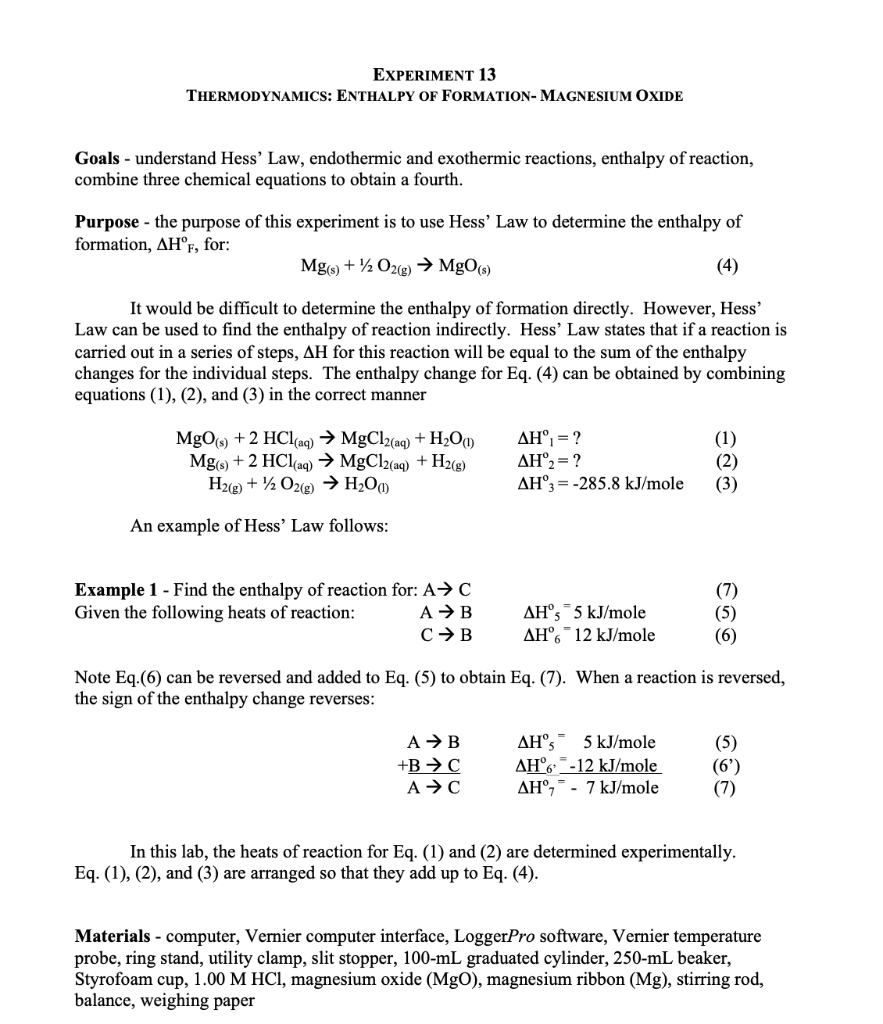
The Correct Answer and Explanation is :
I wasn’t able to access the content you provided directly. However, I can still explain how to determine the enthalpy of formation for magnesium oxide (MgO).
The enthalpy of formation (ΔHf°) of a compound is the change in enthalpy when one mole of a substance is formed from its elements in their standard states at 298 K (25°C). For magnesium oxide, the process involves the formation of MgO from its constituent elements, magnesium (Mg) and oxygen (O2). The reaction can be written as:
[
\text{Mg (s)} + \frac{1}{2} \text{O}_2 (g) \rightarrow \text{MgO (s)}
]
Steps to calculate the enthalpy of formation for MgO:
- Determine the standard enthalpies of formation (ΔHf°): These are the enthalpies of the individual substances in their standard states. The ΔHf° of elements in their standard states is zero. For magnesium (solid) and oxygen (gas), ΔHf° values are 0 kJ/mol.
- Use Hess’s Law: If you have the enthalpy values for related reactions, you can apply Hess’s Law to find the enthalpy of formation. Hess’s Law states that the total enthalpy change of a reaction is the sum of the enthalpy changes of the steps into which the reaction can be divided.
- Standard Enthalpy of Formation for MgO: The enthalpy of formation for magnesium oxide is typically a negative value (exothermic reaction), which means energy is released when magnesium and oxygen react to form MgO.
From known data, the ΔHf° of MgO is approximately -601.6 kJ/mol.
This negative value indicates that the formation of MgO from magnesium and oxygen is an exothermic process, releasing energy. The value is based on experimental measurements under standard conditions, including temperature and pressure.
If you are working with more detailed information or experimental setups, the process may involve additional steps to determine or validate the exact enthalpy change.