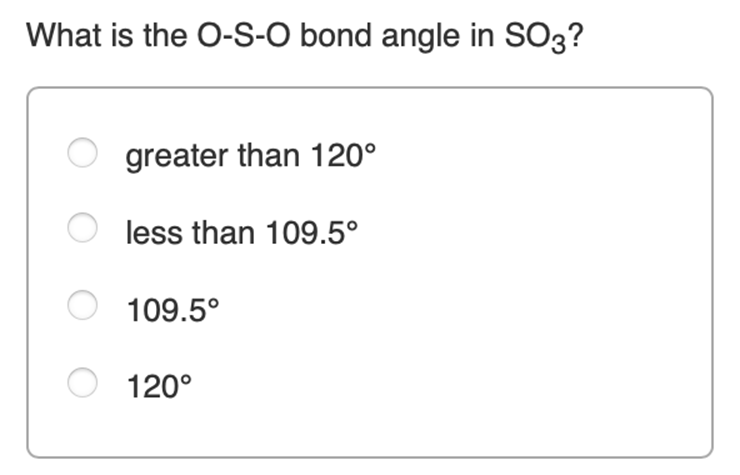
The correct answer and explanation is:
The correct bond angle in sulfur trioxide (SO₃) is 120°.
Explanation:
Sulfur trioxide (SO₃) is a molecule that consists of one sulfur atom centrally bonded to three oxygen atoms. The structure of SO₃ is trigonal planar, which is important in determining the bond angle between the atoms.
To understand the bond angle in SO₃, we need to consider the following points:
- Molecular Geometry: SO₃ adopts a trigonal planar geometry, which means the sulfur atom is in the center of an equilateral triangle formed by the three oxygen atoms. In this geometry, all the bonds are positioned 120° apart, which is characteristic of molecules with three regions of electron density around the central atom.
- Electron Domains: The sulfur atom in SO₃ has three regions of electron density (the three S=O double bonds). Each of these regions repels the others, and the repulsions are minimized when the electron density regions are arranged as far apart as possible. This results in a bond angle of 120° between the oxygen atoms.
- Bonding and Resonance: In SO₃, the sulfur-oxygen bonds are not fixed but resonate. This means that the double bond character is delocalized over all three S=O bonds, leading to equal bond lengths and angles. This delocalization further supports the trigonal planar shape and bond angles of 120°.
- Absence of Lone Pairs: There are no lone pairs of electrons on the sulfur atom in SO₃, so the electron repulsion is evenly distributed among the bonds. If there were lone pairs, they would take up more space and push the bonding pairs closer together, altering the bond angle. However, in this case, the absence of lone pairs allows for the ideal trigonal planar shape with a bond angle of 120°.
Thus, the bond angle in SO₃ is 120°, and this is typical for molecules with a trigonal planar structure.