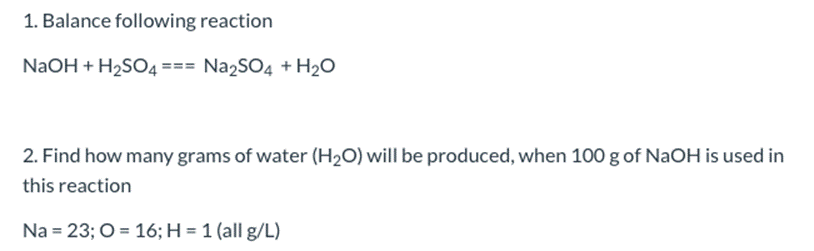
- Balance Following Reaction NaOH + H2SO4 === Na2SO4 + H2O 2. Find How Many Grams Of Water (H2O) Will Be Produced, When 100 G Of NaOH Is Used In This Reaction Na = 23; 0 = 16; H = 1 (All G/L)
The Correct Answer and Explanation is :
The chemical reaction between sodium hydroxide (NaOH) and sulfuric acid (H₂SO₄) is:
[ 2 \, \text{NaOH} + \text{H}_2\text{SO}_4 \rightarrow \text{Na}_2\text{SO}_4 + 2 \, \text{H}_2\text{O} ]
Balanced Equation:
To balance the equation, we ensure that the number of atoms of each element is the same on both sides:
- Sodium (Na): 2 atoms on both sides.
- Hydrogen (H): 4 atoms on both sides.
- Sulfur (S): 1 atom on both sides.
- Oxygen (O): 4 atoms on both sides.
This confirms that the equation is balanced.
Calculating the Mass of Water Produced:
Given that 100 grams of NaOH are used, we can calculate the mass of water produced as follows:
- Molar Masses:
- NaOH: 23 (Na) + 16 (O) + 1 (H) = 40 g/mol
- H₂O: 2 × 1 (H) + 16 (O) = 18 g/mol
- Moles of NaOH:
[ \frac{100 \, \text{g NaOH}}{40 \, \text{g/mol}} = 2.5 \, \text{mol NaOH} ] - Moles of H₂O Produced:
From the balanced equation, 2 moles of NaOH produce 2 moles of H₂O. Therefore, 2.5 moles of NaOH will produce 2.5 moles of H₂O. - Mass of H₂O Produced:
[ 2.5 \, \text{mol H}_2\text{O} \times 18 \, \text{g/mol} = 45 \, \text{g H}_2\text{O} ]
Therefore, 45 grams of water will be produced when 100 grams of NaOH react with excess H₂SO₄.
Explanation:
In this neutralization reaction, NaOH (a strong base) reacts with H₂SO₄ (a strong acid) to form Na₂SO₄ (sodium sulfate) and H₂O (water). The balanced equation indicates that 2 moles of NaOH react with 1 mole of H₂SO₄ to produce 1 mole of Na₂SO₄ and 2 moles of H₂O.
By using stoichiometric calculations, we determine that 100 grams of NaOH will produce 45 grams of water. This calculation is essential in chemical engineering and laboratory settings to predict the outcomes of reactions and to scale up processes efficiently.
Understanding the stoichiometry of reactions allows chemists to determine the exact amounts of reactants needed and the products formed, ensuring reactions proceed as desired and resources are utilized effectively.