Consider the brass alloy for which the stress– strain behavior is shown in Figure 7.12.
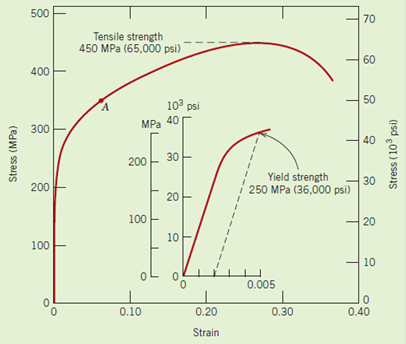
Figure 7.12 The stress–strain behavior for the brass specimen discus.
A cylindrical specimen of this material 10.0 mm (0.39 in.) in diameter and 101.6 mm (4.0 in.) long is pulled in tension with a force of 10,000N(2250 lbf). If it is known that this alloy has a value for Poisson’s ratio of 0.35, compute (a) the specimen elongation, and (b) the reduction in specimen diameter.
The Correct Answer and Explanation is :
To solve for the elongation and reduction in diameter of the cylindrical specimen, we need to use the provided data and apply the principles of material mechanics.
Given:
- Diameter of the specimen, ( D = 10.0 \, \text{mm} )
- Length of the specimen, ( L_0 = 101.6 \, \text{mm} )
- Applied force, ( F = 10,000 \, \text{N} )
- Poisson’s ratio, ( \nu = 0.35 )
- We assume the material behaves linearly (based on the given stress-strain curve) and we can approximate elastic deformation using the material’s Young’s Modulus ( E ).
Step 1: Calculate the stress and strain
- Stress (σ): The applied stress is the force per unit area, calculated as:
[
\sigma = \frac{F}{A}
]
where ( A = \pi \left( \frac{D}{2} \right)^2 ) is the cross-sectional area of the cylindrical specimen. Plugging in the given diameter:
[
A = \pi \left( \frac{10.0 \, \text{mm}}{2} \right)^2 = \pi (5.0 \, \text{mm})^2 = 78.54 \, \text{mm}^2
]
The stress becomes:
[
\sigma = \frac{10,000 \, \text{N}}{78.54 \, \text{mm}^2} = 127.3 \, \text{N/mm}^2 \, (\text{MPa})
] - Strain (ε): Using the linear stress-strain relationship in the elastic region, where strain is proportional to stress by the Young’s Modulus ( E ), we have:
[
\epsilon = \frac{\sigma}{E}
]
We will use the value for the Young’s modulus of brass (about ( E = 100,000 \, \text{MPa} )). Substituting the values:
[
\epsilon = \frac{127.3 \, \text{MPa}}{100,000 \, \text{MPa}} = 0.001273
]
Step 2: Calculate the elongation (ΔL)
The elongation of the specimen is given by:
[
\Delta L = \epsilon L_0
]
Substituting the values:
[
\Delta L = 0.001273 \times 101.6 \, \text{mm} = 0.129 \, \text{mm}
]
Thus, the elongation of the specimen is 0.129 mm.
Step 3: Calculate the reduction in diameter (ΔD)
The reduction in diameter can be calculated using Poisson’s ratio, which relates the lateral strain (in the diameter) to the axial strain (in the length). Poisson’s ratio ( \nu ) is defined as:
[
\nu = -\frac{\text{lateral strain}}{\text{axial strain}}
]
The lateral strain in the diameter is:
[
\epsilon_{\text{lat}} = -\nu \epsilon = -0.35 \times 0.001273 = -0.000445
]
The reduction in diameter is then:
[
\Delta D = \epsilon_{\text{lat}} \times D_0 = -0.000445 \times 10.0 \, \text{mm} = -0.00445 \, \text{mm}
]
Thus, the reduction in diameter is 0.00445 mm (or 4.45 micrometers).
Final Answers:
- Elongation (ΔL): 0.129 mm
- Reduction in diameter (ΔD): 0.00445 mm
Explanation:
This problem is based on the principles of material deformation under tension. The applied force generates a tensile stress, which causes the specimen to elongate and reduce in diameter. The elongation is derived from the axial strain, which is directly proportional to the applied stress, while the reduction in diameter is related to the lateral strain through Poisson’s ratio. The material behaves elastically within the given stress range, allowing us to use simple linear relationships to calculate the deformations.