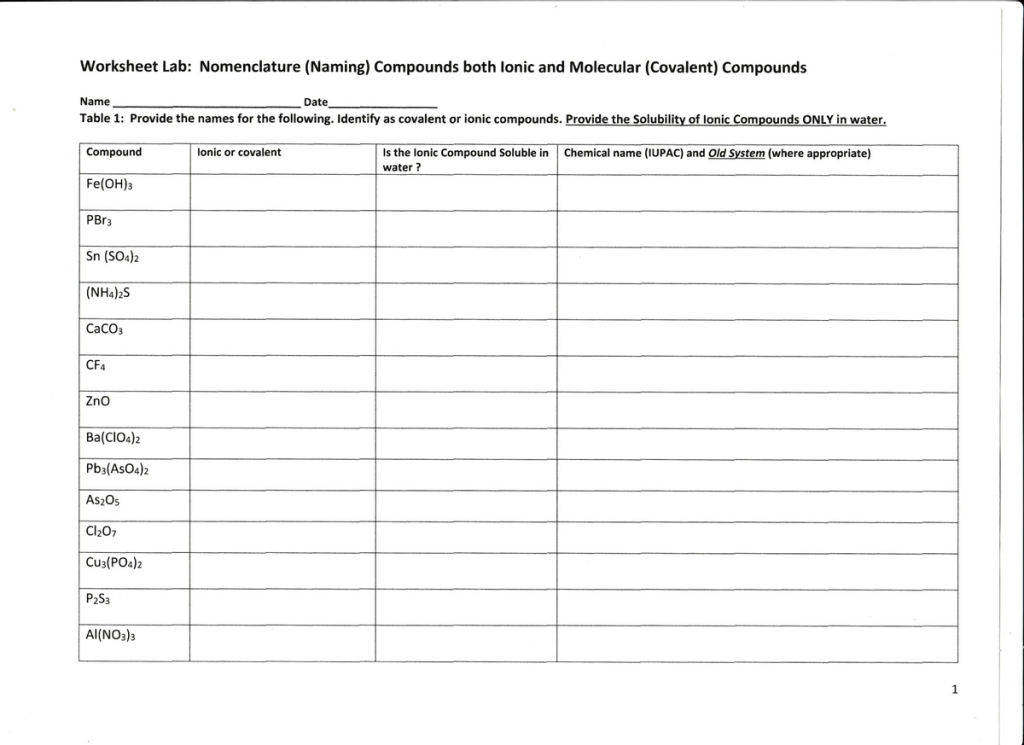
Nomenclature (Naming) Compounds both lonic and Molecular (Covalent) Compounds Name Date_ Table 1: Provide the names for the following. Identify as covalent or ionic compounds. Provide the Solubility of lonic Compounds ONLY in water. Compound Fe(OH)3 PBr3 Sn (SO4)2 (NH4)2S CaCO3 CF4 ZnO Ba(ClO4)2 Pb3(ASO4)2 Asâ‚‚O5 Clâ‚‚O7 Cu3(PO4)2 Pâ‚‚S3 AI(NO3)3 lonic or covalent Is the lonic Compound Soluble in Chemical name (IUPAC) and Old System (where appropriate) water? 1
The Correct Answer and Explanation is :
Here’s a detailed breakdown of the table and answers, followed by an explanation.
Table: Compound Names, Ionic/Covalent Classification, and Solubility in Water
| Compound | Ionic or Covalent | IUPAC Name | Old Name | Solubility in Water (Ionic Only) |
|---|---|---|---|---|
| Fe(OH)₃ | Ionic | Iron(III) hydroxide | Ferric hydroxide | Insoluble |
| PBr₃ | Covalent | Phosphorus tribromide | N/A | N/A |
| Sn(SO₄)₂ | Ionic | Tin(IV) sulfate | Stannic sulfate | Soluble |
| (NH₄)₂S | Ionic | Ammonium sulfide | N/A | Soluble |
| CaCO₃ | Ionic | Calcium carbonate | N/A | Insoluble |
| CF₄ | Covalent | Carbon tetrafluoride | N/A | N/A |
| ZnO | Ionic | Zinc oxide | N/A | Insoluble |
| Ba(ClO₄)₂ | Ionic | Barium perchlorate | N/A | Soluble |
| Pb₃(AsO₄)₂ | Ionic | Lead(II) arsenate | Plumbous arsenate | Insoluble |
| As₂O₅ | Covalent | Diarsenic pentoxide | N/A | N/A |
| Cl₂O₇ | Covalent | Dichlorine heptoxide | N/A | N/A |
| Cu₃(PO₄)₂ | Ionic | Copper(II) phosphate | Cupric phosphate | Insoluble |
| P₂S₃ | Covalent | Diphosphorus trisulfide | N/A | N/A |
| Al(NO₃)₃ | Ionic | Aluminum nitrate | N/A | Soluble |
Explanation
- Classification of Ionic vs. Covalent Compounds:
- Ionic compounds: These are formed between metals and non-metals, involving the transfer of electrons. Examples include Fe(OH)₃ and Ba(ClO₄)₂.
- Covalent compounds: These are formed between non-metals by sharing electrons, e.g., PBr₃ and Cl₂O₇.
- IUPAC and Old System Naming:
- The IUPAC system is the modern method, emphasizing oxidation states and systematic prefixes.
- The old system uses traditional names (e.g., “ferric hydroxide” for Fe(OH)₃).
- Solubility in Water (for Ionic Compounds):
- Solubility depends on the compound’s lattice energy and interactions with water.
- Soluble ionic compounds include those with nitrate (NO₃⁻) or ammonium (NH₄⁺) ions, e.g., Al(NO₃)₃ and (NH₄)₂S.
- Insoluble examples include compounds with carbonate (CO₃²⁻) or hydroxide (OH⁻), such as CaCO₃ and Fe(OH)₃, which form precipitates.
By understanding naming conventions and solubility rules, you can systematically identify and categorize compounds. These skills are essential for analyzing reactions, predicting products, and understanding chemical behavior.