Use the given transformation to graph the function. Note the vertical and horizontal asymptotes. The reciprocal squared function f (x) = 2 shifted to the right 2 units. Hint: The graph of the reciprocal square function is shown in Figure 1 in the Reading and Participation Activities section on Rational Functions. Select the correct graph of the function.
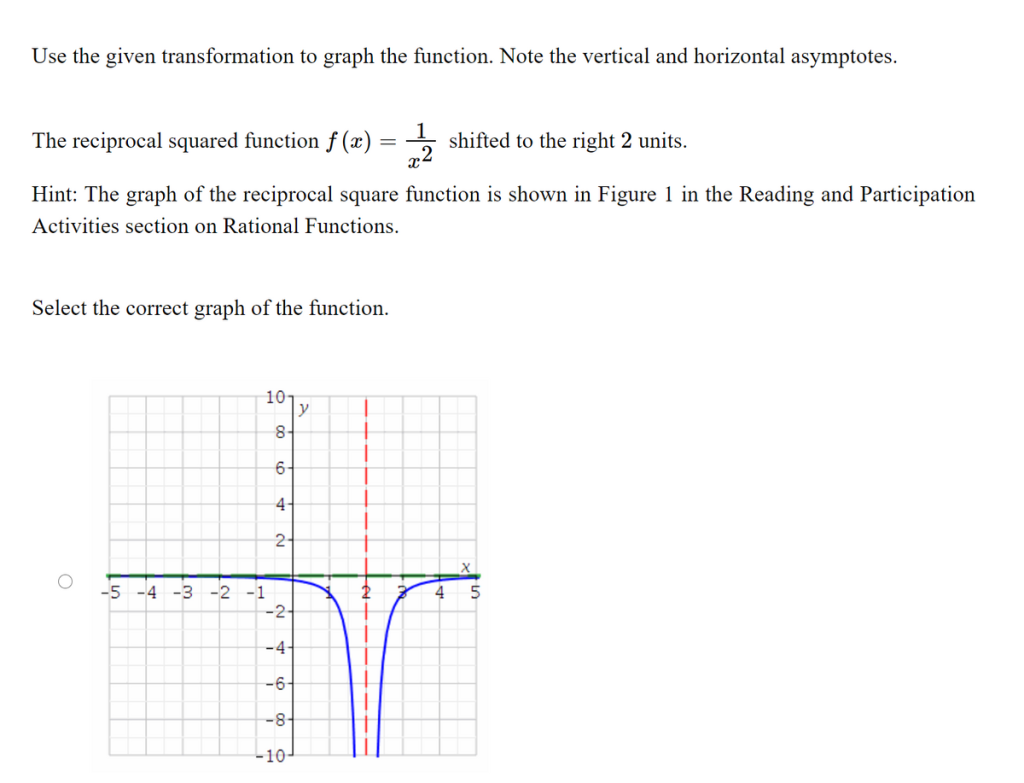
The Correct Answer and Explanation is :
To graph the given function, we start with the reciprocal squared function ( f(x) = \frac{1}{x^2} ), and apply the specified transformations:
- Start with the reciprocal squared function: The base function is ( f(x) = \frac{1}{x^2} ). It has:
- A vertical asymptote at ( x = 0 ), since ( \frac{1}{x^2} ) becomes undefined at ( x = 0 ).
- A horizontal asymptote at ( y = 0 ), since as ( |x| \to \infty ), ( \frac{1}{x^2} \to 0 ).
- Shift the function to the right by 2 units: To shift the function ( f(x) = \frac{1}{x^2} ) to the right by 2 units, replace ( x ) with ( x – 2 ). This gives the transformed function:
[
f(x) = \frac{1}{(x – 2)^2}.
]
- The vertical asymptote moves from ( x = 0 ) to ( x = 2 ).
- The horizontal asymptote remains at ( y = 0 ), as the shift does not affect the long-term behavior of the function.
- Multiply by 2: Finally, multiply the function by 2:
[
f(x) = \frac{2}{(x – 2)^2}.
]
This stretches the graph vertically by a factor of 2, making it rise faster as ( x ) approaches the vertical asymptote from either side.
Key Features of the Final Graph:
- Vertical Asymptote: ( x = 2 ).
- Horizontal Asymptote: ( y = 0 ).
- Behavior:
- As ( x \to 2^+ ) or ( x \to 2^- ), ( f(x) \to \infty ).
- As ( x \to \pm \infty ), ( f(x) \to 0^+ ).
The correct graph will show a hyperbolic curve with the specified asymptotes and a steeper rise due to the vertical stretch. Based on the provided figure, match these characteristics to the correct graph.