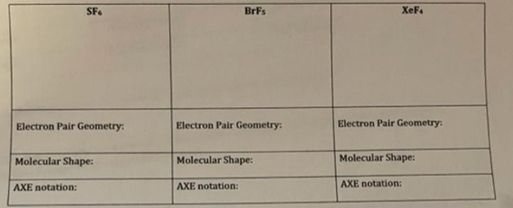
Fill in the table with the 3D Lewis structures and answer the questions for sulfur hexafluoride (SF6). bromine pentafluoride (BrF5), and xenon tetrafluoride (XeF4).
A. How do the exact bond angles in xenon tetrafluoride compare to the ideal bond angles of an octahedron? Why or why aren’t they distorted?
B. What is the rule for where the 1 and 2nd groups of non-bonding electrons should go in structures with 6 electron domains?
The Correct Answer and Explanation is :
Lewis Structures and 3D Shapes of SF₆, BrF₅, and XeF₄
1. Sulfur Hexafluoride (SF₆)
- Lewis Structure: Sulfur atom at the center, surrounded by six fluorine atoms with single bonds. Each fluorine has three lone pairs, and sulfur has no lone pairs.
- Shape: Octahedral.
- Bond Angles: Ideal 90° and 180° angles.
2. Bromine Pentafluoride (BrF₅)
- Lewis Structure: Bromine atom at the center, surrounded by five fluorine atoms with single bonds, and one lone pair on bromine.
- Shape: Square pyramidal.
- Bond Angles: Slightly less than 90° due to the lone pair causing repulsion.
3. Xenon Tetrafluoride (XeF₄)
- Lewis Structure: Xenon atom at the center, surrounded by four fluorine atoms with single bonds and two lone pairs on xenon.
- Shape: Square planar.
- Bond Angles: 90° and 180° (no distortion).
A. Bond Angles in XeF₄ Compared to Ideal Octahedral
In an ideal octahedral geometry, the bond angles are 90° and 180°. Xenon tetrafluoride retains these ideal bond angles because the two lone pairs are positioned opposite each other, minimizing repulsion and maintaining the square planar symmetry. The even distribution of electron density ensures no distortion of bond angles.
The symmetry and equal repulsion between lone pairs ensure the geometry stays undistorted. Unlike geometries with an uneven number of lone pairs (e.g., BrF₅), XeF₄ achieves a balanced configuration, preserving its ideal angles.
B. Rule for Non-Bonding Electron Placement in Six Electron Domains
In molecules with six electron domains, lone pairs are placed to minimize electron repulsion. The first and second groups of non-bonding electrons occupy positions directly opposite each other (axial positions in an octahedral framework). This arrangement maximizes separation between the lone pairs and bonded pairs, reducing repulsion.
Explanation (300 Words)
The placement of lone pairs in six-electron-domain structures adheres to the principle of minimizing electron repulsion, as described by the Valence Shell Electron Pair Repulsion (VSEPR) theory. In an octahedral geometry, six positions surround the central atom symmetrically. To reduce repulsion, lone pairs are placed at opposite ends of the molecule (axial positions).
For example, in xenon tetrafluoride (XeF₄), the two lone pairs on xenon occupy opposite axial positions. This arrangement ensures the four bonding pairs form a square planar shape with minimal distortion, maintaining 90° and 180° bond angles. Conversely, in bromine pentafluoride (BrF₅), a single lone pair causes slight distortions because its repulsion affects adjacent bonding pairs.
This rule reflects the inherent symmetry and efficiency of electron distribution in molecules. Axial placement minimizes lone-pair–bond-pair repulsion, preserving ideal geometry where possible. The principle applies universally to molecules with six electron domains, such as SF₆ (no lone pairs) and XeF₄ (two lone pairs), maintaining stability and symmetry in molecular structures.