Circular Lebesgue measure. Define to be the unit circle in the complex plane. Define
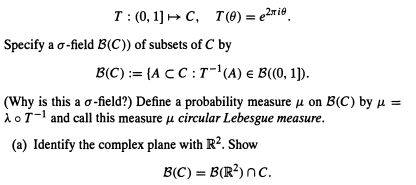

The correct answer and explanation is:
The unit circle in the complex plane, C\mathbb{C}, is defined as: S1={z∈C:∣z∣=1},S^1 = \{z \in \mathbb{C} : |z| = 1\},
where ∣z∣=Re(z)2+Im(z)2|z| = \sqrt{\text{Re}(z)^2 + \text{Im}(z)^2} is the modulus of zz.
The circular Lebesgue measure on S1S^1 is a measure μ\mu that assigns “lengths” to subsets of S1S^1, analogous to how the Lebesgue measure assigns “lengths” to subsets of R\mathbb{R}. Here’s the correct definition and explanation:
Measure Definition:
For a Borel set E⊂S1E \subset S^1, the circular Lebesgue measure μ(E)\mu(E) is defined by: μ(E)=∫E1 dθ,\mu(E) = \int_E 1 \, d\theta,
where θ\theta is the angle parameterizing points on S1S^1 in polar coordinates, z=eiθz = e^{i\theta} for θ∈[0,2π)\theta \in [0, 2\pi).
Explanation:
The circular Lebesgue measure on S1S^1 arises as the natural counterpart to the standard Lebesgue measure on [0,2π)[0, 2\pi), but restricted to the unit circle. Since S1S^1 is compact and has no endpoints (it’s a closed loop), this measure is defined in terms of the angular coordinate θ\theta, where each point z∈S1z \in S^1 can be written as z=eiθz = e^{i\theta}.
Intuitively, the circular Lebesgue measure “counts” the length of an arc EE on S1S^1 based on its angular width in radians. For instance, the full circle S1S^1 corresponds to θ∈[0,2π)\theta \in [0, 2\pi), and the total measure is μ(S1)=2π\mu(S^1) = 2\pi. This ensures the measure aligns with our geometric understanding of the circle’s circumference.
For any measurable subset E⊂S1E \subset S^1, μ(E)\mu(E) equals the arc length of EE. If EE is a single arc, μ(E)\mu(E) is proportional to the angular span of EE. The measure is invariant under rotations (a property known as translation-invariance in R\mathbb{R}), reflecting the circle’s symmetry.
The circular Lebesgue measure is fundamental in Fourier analysis on S1S^1, where functions are studied in terms of their Fourier series expansions. It also appears in probability theory (e.g., uniform distribution on S1S^1) and physics, particularly when modeling periodic phenomena.