Place the events leading to inspiration in correct order.
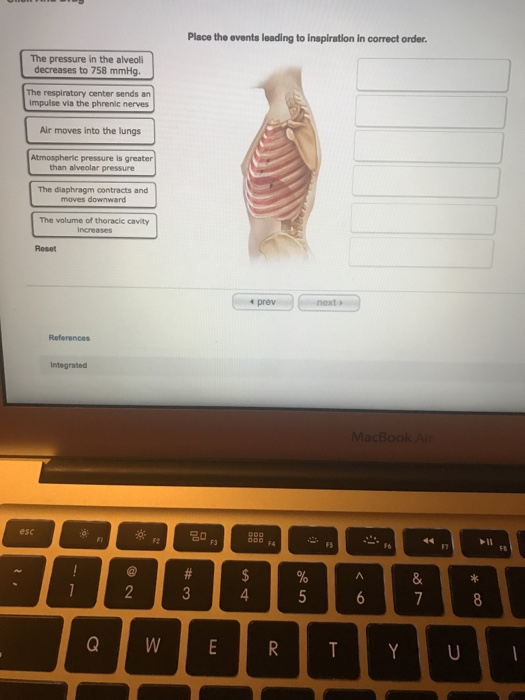
The correct answer and explanation is:
Correct Order of Events Leading to Inspiration:
- Diaphragm contracts and flattens.
- External intercostal muscles contract, lifting the ribs upward and outward.
- Thoracic cavity volume increases.
- Lung pressure decreases below atmospheric pressure.
- Air flows into the lungs.
Explanation:
Inspiration, or inhalation, is the process of drawing air into the lungs, driven by pressure differences between the atmosphere and the lungs. It relies on coordinated actions of respiratory muscles and changes in thoracic cavity volume.
- Diaphragm contracts and flattens: The diaphragm, a dome-shaped muscle separating the thoracic and abdominal cavities, is the primary driver of inspiration. When it contracts, it flattens and moves downward, increasing the vertical dimension of the thoracic cavity.
- External intercostal muscles contract: These muscles, located between the ribs, contract simultaneously. This action elevates the rib cage and sternum, causing the thoracic cavity to expand outward and upward, further increasing its volume.
- Thoracic cavity volume increases: The combined effects of the diaphragm’s downward movement and the rib cage’s outward expansion result in a significant increase in thoracic cavity volume. This expansion stretches the lungs due to their elastic properties and their attachment to the thoracic walls via the pleural membranes.
- Lung pressure decreases below atmospheric pressure: As the thoracic cavity expands, the pressure within the lungs (intrapulmonary pressure) drops below atmospheric pressure. This creates a pressure gradient that facilitates air movement.
- Air flows into the lungs: Air naturally moves from areas of higher pressure (the atmosphere) to areas of lower pressure (the lungs). This process continues until the intrapulmonary pressure equals atmospheric pressure, completing inspiration.
The efficiency of this process is critical for gas exchange, ensuring oxygen enters the lungs and carbon dioxide is expelled during expiration. Proper coordination of these events is vital for maintaining homeostasis and meeting the body’s metabolic demands.