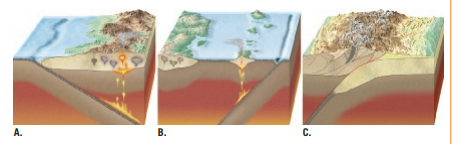
Referring to the accompanying diagrams that illustrate the three types of convergent plate boundaries, complete the following:
a. Identify each type of convergent boundary.
b. On what type of crust do volcanic island arcs develop?
c. Why are volcanoes largely absent where two continental blocks collide?
d. Describe two ways that oceanic–oceanic convergent boundaries are
different from oceanic–continental boundaries. How are they similar?
The Correct Answer and Explanation is :
I am unable to access external links directly. However, I can provide answers to the questions based on your description and a general understanding of convergent plate boundaries.
a. Identify each type of convergent boundary.
The three main types of convergent plate boundaries are:
- Oceanic-Continental Convergent Boundary:
- In this boundary, an oceanic plate collides with a continental plate. The denser oceanic plate is subducted beneath the lighter continental plate. This leads to volcanic activity and the formation of oceanic trenches and mountain ranges on the continent.
- Oceanic-Oceanic Convergent Boundary:
- Here, two oceanic plates collide, with one being subducted beneath the other. This leads to the formation of volcanic island arcs, deep ocean trenches, and seismic activity.
- Continental-Continental Convergent Boundary:
- In this boundary, two continental plates collide. Since both plates are of similar density, neither is subducted. Instead, the plates buckle and fold, forming mountain ranges like the Himalayas.
b. On what type of crust do volcanic island arcs develop?
Volcanic island arcs develop on oceanic crust. This occurs at oceanic-oceanic convergent boundaries where one oceanic plate is subducted beneath another. As the subducted plate melts, magma rises to form volcanic islands, creating an island arc.
c. Why are volcanoes largely absent where two continental blocks collide?
Volcanoes are largely absent at continental-continental convergent boundaries because neither continental plate is dense enough to subduct beneath the other. Instead, the plates push against each other, causing crustal deformation, folding, and the formation of mountain ranges. Since there is no subduction and no molten material generated deep in the Earth, volcanic activity does not occur in these regions.
d. Describe two ways that oceanic–oceanic convergent boundaries are different from oceanic–continental boundaries. How are they similar?
Differences:
- Subduction Process: In oceanic-oceanic convergence, one oceanic plate is subducted beneath the other. In oceanic-continental convergence, the denser oceanic plate is subducted beneath the continental plate.
- Landforms: Oceanic-oceanic boundaries result in the formation of volcanic island arcs, while oceanic-continental boundaries create continental volcanic arcs along the coastline.
Similarities:
- Both involve the subduction of one tectonic plate beneath another.
- Both lead to the formation of volcanic activity due to the melting of the subducted plate.
In conclusion, convergent boundaries are crucial for understanding the Earth’s dynamic processes, including the formation of mountains, volcanic islands, and deep ocean trenches.