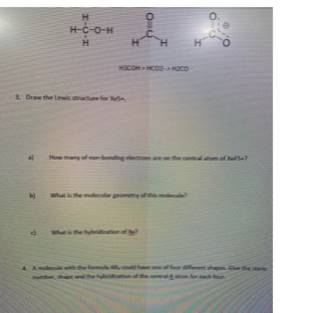
H-C-0-H o H3COH > HCO2-> H2CO 3. Draw the Lewis structure for Xe5+. a) How many of non-bonding electrons are on the central atom of XeF5+? b) What is the molecular geometry of this molecule? c) What is the hybridization of Xe? 4. A molecule with the formula AB3 could have one of four different shapes. Give the steric number, shape and the hybridization of the central A atom for each four
The Correct Answer and Explanation is :
3. Lewis Structure for XeF5+ (Xenon Pentafluoride Cation):
a) Non-bonding electrons on the central atom (Xe) in XeF5+:
To determine the number of non-bonding electrons on the central atom, we first need to look at the electron configuration and bonding of the molecule.
- Xenon (Xe) is in Group 18, so it initially has 8 valence electrons.
- Each fluorine (F) atom, as a halogen, has 7 valence electrons.
- The +1 charge indicates that one electron has been removed from the overall molecule.
- The central Xe atom forms 5 bonds with 5 fluorine atoms.
Let’s summarize:
- Total valence electrons = (8 from Xe) + (5 × 7 from 5 fluorines) – 1 (for the positive charge) = 8 + 35 – 1 = 42 valence electrons.
- Xenon forms 5 bonds with fluorine atoms, so 5 bonding pairs are shared. Each bonding pair accounts for 2 electrons. So, 10 electrons are used in bonds.
- The remaining 32 electrons will be placed as lone pairs (non-bonding electrons) around the fluorine atoms. Since each fluorine atom takes 3 lone pairs, all 5 fluorine atoms contribute 15 electrons. The remaining 17 electrons are distributed on the xenon atom. Xenon has a pair of lone electrons on it.
Thus, the central atom, Xenon, has 2 non-bonding electrons.
b) Molecular Geometry of XeF5+:
To determine the molecular geometry, we need to know the arrangement of bonds and lone pairs around the central atom. The steric number (the number of regions of electron density) will help determine this.
- The central Xenon atom has 5 bonding pairs (from the fluorine atoms) and 1 lone pair.
- The shape of XeF5+ is square pyramidal, due to the presence of 5 bonding pairs and 1 lone pair around the central atom.
c) Hybridization of Xenon in XeF5+:
- The steric number of Xe in XeF5+ is 6 (5 bonding pairs + 1 lone pair).
- Therefore, the hybridization of Xenon is sp3d2.
4. Molecule AB3 and Its Geometries:
A molecule with the formula AB3 can have four different possible shapes depending on the electron pair geometry and the number of lone pairs on the central atom A. For each shape, the steric number, molecular geometry, and hybridization of the central atom are as follows:
- Steric number 3:
- Shape: Trigonal planar
- Hybridization: sp2
- Explanation: If there are no lone pairs on A, the molecule will adopt a trigonal planar geometry.
- Steric number 3 with one lone pair:
- Shape: Bent or Angular
- Hybridization: sp2
- Explanation: With one lone pair, the molecule adopts a bent or angular shape with a steric number of 3.
- Steric number 4:
- Shape: Tetrahedral
- Hybridization: sp3
- Explanation: If there are no lone pairs on A and 4 regions of electron density, the shape will be tetrahedral.
- Steric number 4 with one lone pair:
- Shape: Trigonal pyramidal
- Hybridization: sp3
- Explanation: If there is one lone pair on the central atom, the shape is trigonal pyramidal.
Each of these shapes depends on how many lone pairs are around the central atom, and that dictates the steric number, geometry, and hybridization.