A man, attempting a daring dive off a high cliff into a small swimming hole, runs horizontally off the cliff at 11m/s. The cliff is 50m high and the center of the pool, the only safe place to land, is located 50m from the base of the cliff. Does he under shoot, over shoot, or perfectly land in the center? Calculate for all variables. Tdown DE D, V cesultat Angleland
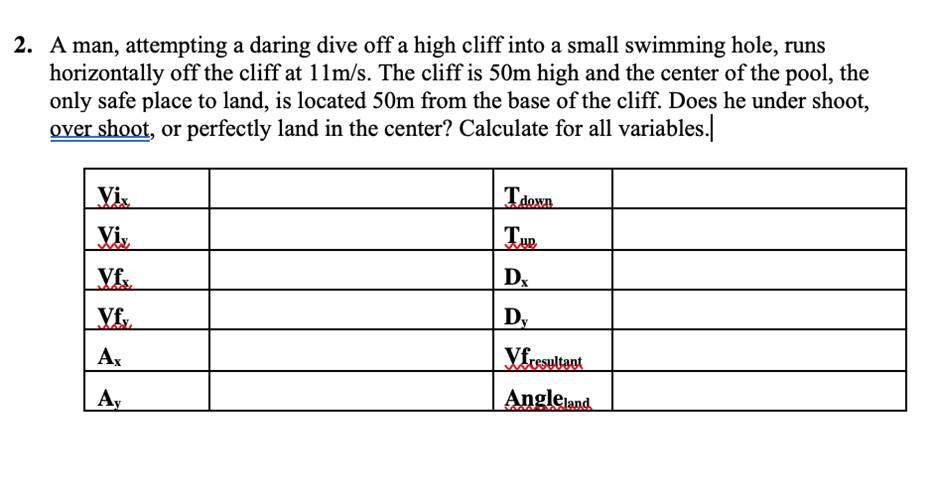
The Correct Answer and Explanation is :
To determine whether the man will land in the center of the pool, we need to analyze his horizontal and vertical motions separately, assuming no air resistance.
Given:
- Initial horizontal velocity ((v_x)) = 11 m/s
- Cliff height ((h)) = 50 m
- Horizontal distance to the pool center ((d)) = 50 m
- Acceleration due to gravity ((g)) = 9.81 m/s²
Vertical Motion Analysis:
The time ((t)) it takes for the man to reach the water can be calculated using the free-fall equation:
[ t = \sqrt{\frac{2h}{g}} ]
Calculating:
calculatorturn0calculator0
So, ( t \approx 3.19 ) seconds.
Horizontal Motion Analysis:
The horizontal distance traveled ((x)) is given by:
[ x = v_x \times t ]
Calculating:
calculatorturn0calculator1
So, ( x \approx 35.12 ) meters.
Conclusion:
The man will land approximately 35.12 meters from the base of the cliff, which is less than the 50 meters required to reach the pool’s center. Therefore, he will undershoot and land before reaching the pool.
Explanation:
In projectile motion without air resistance, the horizontal velocity remains constant throughout the flight, while the vertical velocity increases due to gravity. By calculating the time to fall and the horizontal distance traveled during that time, we can determine the landing position. In this scenario, the insufficient horizontal distance indicates that the initial horizontal velocity is too low to reach the pool’s center