Arestaurant chains owners are trying to decide if they want to open up a franchise in your town. To help (2 points) 1. them decide, they want to find out how often people in your town g out to eat. A researcher interviews people leavinga local restaurant. Isthere a bias in this sampling method? Explain. Essay
The Correct Answer and Explanation is :
Yes, there is a potential bias in this sampling method. In the scenario described, a researcher interviews people leaving a local restaurant to determine how often people in the town go out to eat. This approach can lead to a sampling bias because the sample being studied (people leaving the restaurant) is not representative of the entire population of the town.
The first issue is that people leaving the restaurant are likely individuals who have already chosen to eat out, indicating that they are more inclined to dine at restaurants than the general population. This group does not reflect those who might rarely or never go out to eat. Therefore, the data collected would overestimate the frequency of dining out in the town, as it doesn’t account for people who stay home and eat or prefer cooking at home.
Moreover, by only sampling people who have just left a restaurant, the researcher overlooks the behaviors and preferences of individuals who may not visit restaurants at all, such as those who cook most of their meals at home or do not have the means to dine out. This limits the diversity of the sample, and it fails to include crucial demographic factors like income, family size, dietary preferences, and cultural habits that may influence dining habits.
To obtain more accurate and generalizable results, the researcher should employ a more inclusive sampling method, such as random sampling across different neighborhoods and times of day. This would ensure that the sample includes individuals who do not frequent restaurants as well as those who do. By broadening the scope of the survey, the researcher would gather a more representative set of data that accurately reflects how often people in the town go out to eat.
Let me now generate an image that illustrates this concept.
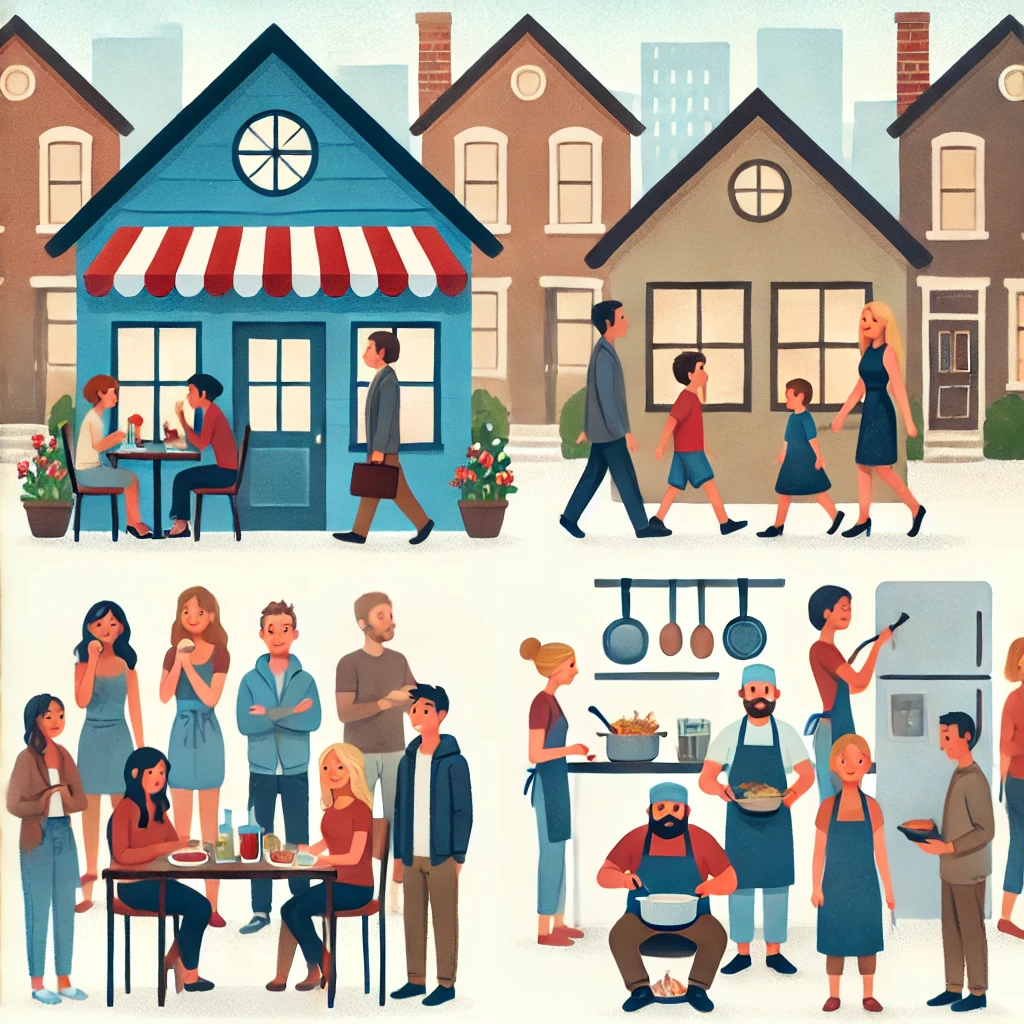
Here is an illustration showing two groups of people: one group leaving a restaurant and another group staying at home or cooking in their kitchen. This image visualizes the concept of sampling bias, as people leaving a restaurant may not represent the entire population of the town. The people at home are depicted as a diverse group, emphasizing the need for a more inclusive sampling method.