Utilizing PCR requires all of the steps except
All the steps listed are required when utilizing genetic PCR. ?amplifying the DNA of interest.
transforming cells so that, in the pool of cells, all genes are represented. denaturing the DNA.
extending the DNA using tSaq polymerase.
The correct answer and explanation is:
The correct answer is:
“Transforming cells so that, in the pool of cells, all genes are represented.”
Explanation:
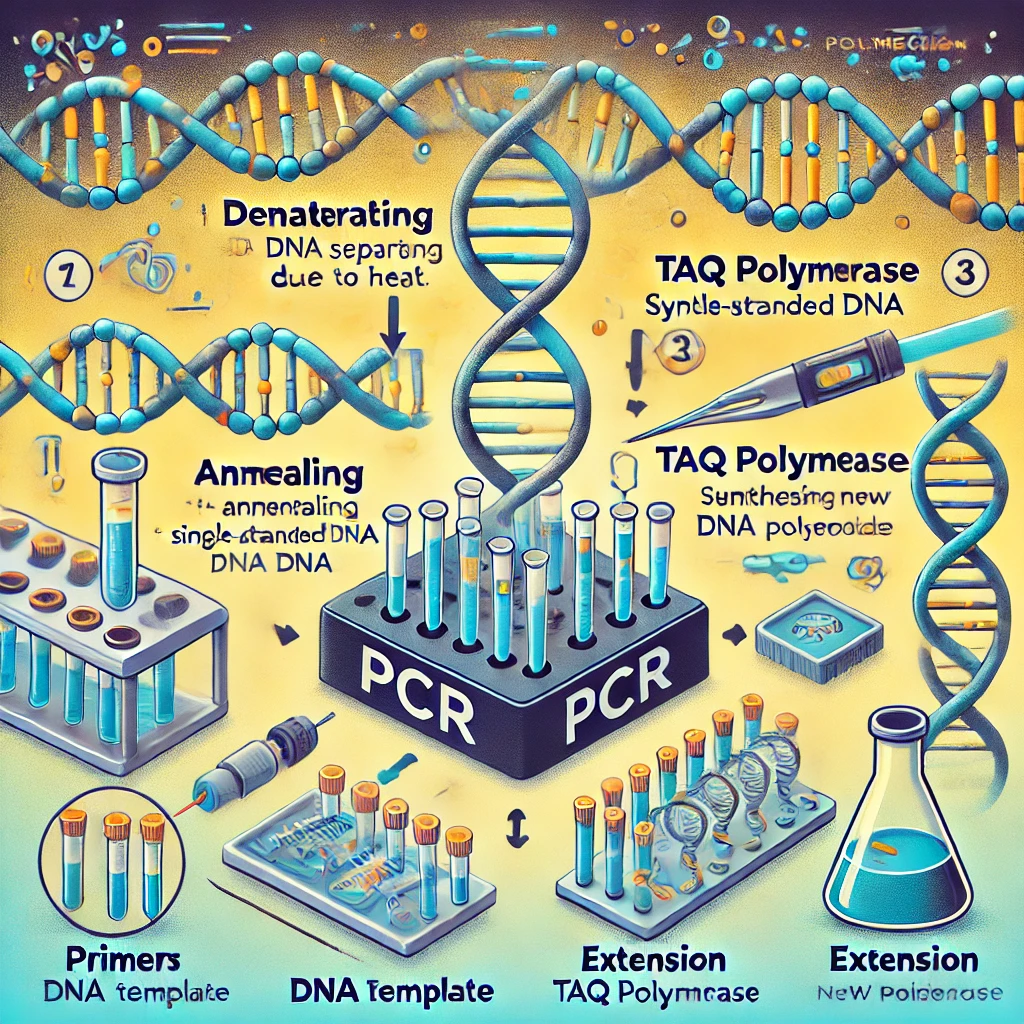
Polymerase Chain Reaction (PCR) is a widely used technique in molecular biology to amplify DNA sequences. It is a rapid and efficient method that can generate millions to billions of copies of a specific DNA fragment. PCR follows a cycle of three major steps: denaturation, annealing, and extension.
- Denaturation: The double-stranded DNA is heated to a high temperature (usually around 94–98°C) to break the hydrogen bonds between the bases, resulting in two single strands of DNA.
- Annealing: The reaction temperature is lowered (typically 50–65°C), allowing short DNA primers to bind to the complementary sequences on the single-stranded DNA. These primers define the region of DNA to be amplified.
- Extension: Taq polymerase, a heat-stable enzyme, adds nucleotides to the primers in a 5′ to 3′ direction, synthesizing new DNA strands. This step occurs at around 72°C.
These steps are repeated for multiple cycles, exponentially increasing the number of DNA copies.
Why “Transforming cells” is NOT a PCR step?
Transformation refers to introducing foreign DNA into bacterial or eukaryotic cells, allowing cells to take up genetic material. This process is commonly used in cloning, genetic engineering, and recombinant DNA technology but is not a required step in PCR. PCR occurs in a test tube and does not involve living cells; instead, it uses a DNA template, primers, nucleotides, and Taq polymerase to amplify a specific DNA sequence.
Thus, while transformation is essential in molecular biology for introducing genes into organisms, it is not a step in PCR.
I have provided a scientific illustration of the PCR process, including the key stages: denaturation, annealing, and extension, along with labeled components such as DNA template, primers, Taq polymerase, and nucleotides. Let me know if you need any modifications or further explanations!