What are 2 scenarios in which you would use a Bank deposit transaction?
A. When your client wants to make a deposit to a vendor
B. When your client wants to group customer payments into a single deposit transaction
C. When your client wants to apply a customer payment to an open invoice
D. When your client wants to record an SBA loan amount received
E. When your client wants to record sales from her upcoming trade show and provide sales receipts
The Correct Answer and Explanation is :
The two correct scenarios where you would use a Bank Deposit transaction are:
B. When your client wants to group customer payments into a single deposit transaction
D. When your client wants to record an SBA loan amount received
Explanation:
Scenario B: Grouping Customer Payments into a Single Deposit
When a client receives multiple payments from customers, instead of recording each payment as a separate deposit in the bank account, they might want to group all these customer payments into one consolidated deposit. This simplifies the accounting process by reducing the number of individual transactions that need to be tracked. A Bank Deposit is used in this case to record multiple payments received, such as checks, cash, or electronic transfers, that are deposited into the client’s bank account in one lump sum.
In accounting systems like QuickBooks, this deposit transaction allows the user to match individual customer payments with the corresponding bank deposit, helping to ensure that the bank balance and the accounting records are in sync. This method is efficient and accurate for businesses that handle a large volume of customer payments, ensuring that payments are recorded in the right period and that the bank statement is easily reconciled.
Scenario D: Recording an SBA Loan Amount Received
In another scenario, when a client receives a loan, such as an SBA (Small Business Administration) loan, the money deposited into the business’s bank account needs to be recorded. A Bank Deposit transaction is ideal for this because the loan is typically deposited as a lump sum into the business’s checking account. The deposit transaction will allow the client to accurately record the loan amount as a deposit, and link it to the appropriate liability account in their accounting system.
This ensures that the business’s balance sheet reflects the loan liability, and the cash inflow from the loan is properly recorded in the cash account, showing up as an increase in the bank balance. Using a Bank Deposit transaction helps businesses track the receipt of large sums of money, such as loans or other non-operational income.
Why the Other Options Are Incorrect:
- A. When your client wants to make a deposit to a vendor: This refers to paying money to a vendor, which would be an expense or bill payment, not a bank deposit.
- C. When your client wants to apply a customer payment to an open invoice: This is an accounting action related to accounts receivable and doesn’t involve a bank deposit.
- E. When your client wants to record sales from her upcoming trade show and provide sales receipts: This involves recording income from sales, typically done through sales receipts or invoices, not a bank deposit.
Visual Representation
Let me generate a simple diagram that visualizes these scenarios in an easy-to-understand way.
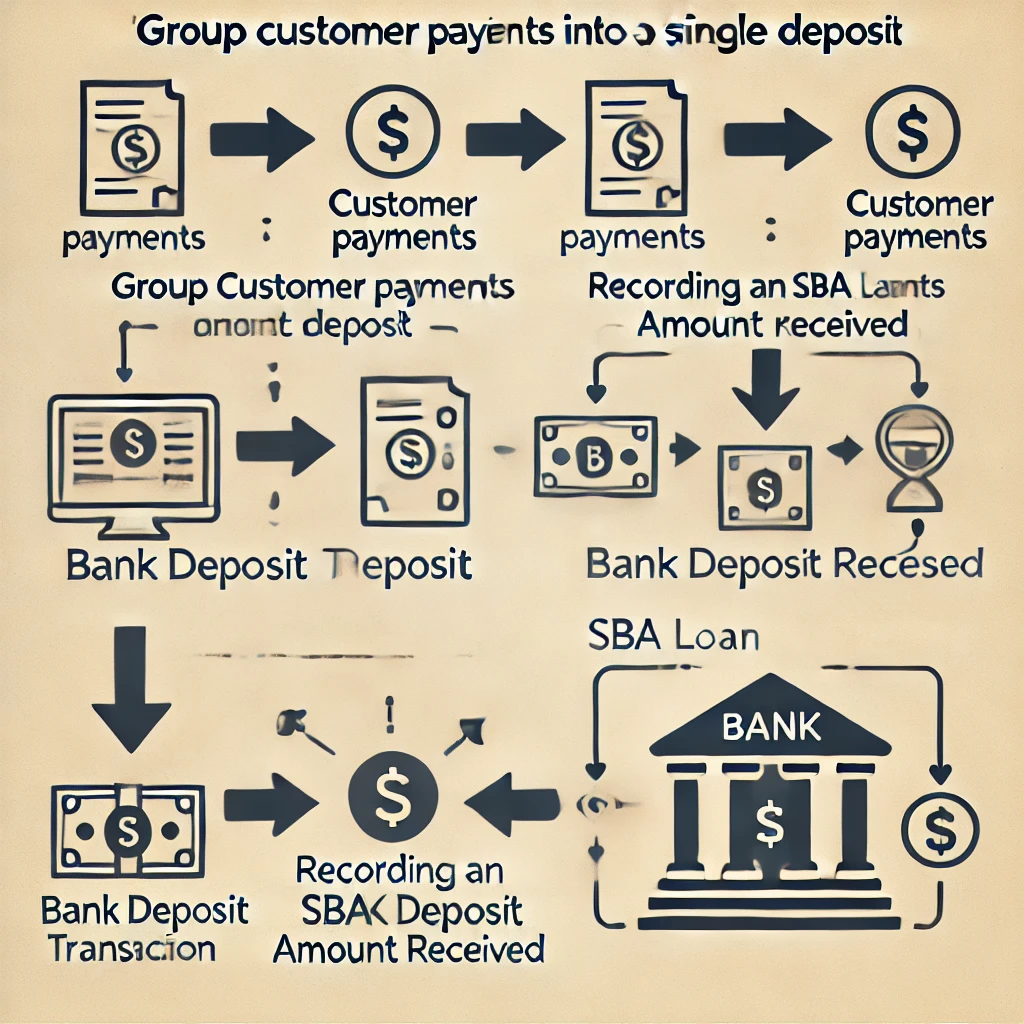
Here is a visual representation of the two scenarios where a Bank Deposit transaction would be used:
- Grouping Customer Payments into a Single Deposit
- Recording an SBA Loan Amount Received