Classify the following monosaccharides. (Examples: D-aldohexose, L-ketotetrose.)
(a) (+)-glucose (b)(-)-arabinose (c) L-fructose
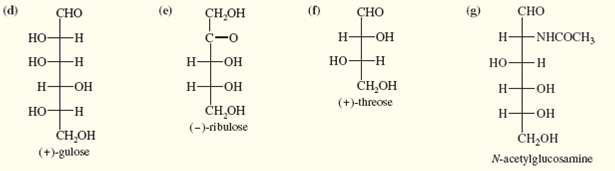
The correct answer and explanation is :
The classification of monosaccharides is based on two factors:
- The number of carbon atoms (triose, tetrose, pentose, hexose, etc.).
- The functional group (aldose if it has an aldehyde group, ketose if it has a ketone group).
- The stereochemistry (D or L configuration, based on the chiral carbon farthest from the carbonyl group in comparison to glyceraldehyde).
Classification of the given monosaccharides
(a) (+)-Glucose
- Glucose is a six-carbon sugar (hexose).
- It has an aldehyde functional group (aldose).
- It is dextrorotatory (+), meaning it rotates plane-polarized light to the right.
- The naturally occurring form is D-glucose.
- Classification: D-aldohexose.
(b) (-)-Arabinose
- Arabinose is a five-carbon sugar (pentose).
- It has an aldehyde functional group (aldose).
- It is levorotatory (-), meaning it rotates plane-polarized light to the left.
- The naturally occurring form is L-arabinose.
- Classification: L-aldopentose.
(c) L-Fructose
- Fructose is a six-carbon sugar (hexose).
- It has a ketone functional group (ketose).
- The given fructose is specifically L-fructose, meaning the configuration of the chiral carbon farthest from the carbonyl group is opposite to that of D-fructose.
- Classification: L-ketohexose.
Explanation
The classification of monosaccharides follows a systematic approach. The number of carbon atoms determines the root name (triose, tetrose, pentose, hexose). The presence of either an aldehyde or ketone functional group determines whether the sugar is an aldose or ketose. Lastly, the stereochemistry (D or L) is based on the reference molecule glyceraldehyde. If the hydroxyl (-OH) group on the penultimate carbon (the chiral carbon furthest from the carbonyl) is on the right, the sugar is classified as D; if it is on the left, it is classified as L.
This classification helps in understanding carbohydrate metabolism, as enzymes often differentiate between D- and L-forms.