Discuss advantages and disadvantages of both (Hard Disk Drive and Solid-State Drive ) in storage
The Correct Answer and Explanation is :
Advantages and Disadvantages of Hard Disk Drive (HDD) and Solid-State Drive (SSD)
Hard Disk Drive (HDD):
Advantages:
- Cost-Effective: HDDs are generally cheaper per gigabyte compared to SSDs, making them ideal for large storage capacities on a budget.
- Larger Storage Capacity: HDDs typically offer larger storage sizes, often exceeding 1TB, which is beneficial for those needing to store large amounts of data.
- Mature Technology: HDDs have been around for decades and are widely available with established technology, making them a dependable option for most users.
Disadvantages:
- Slower Speed: HDDs have slower read/write speeds due to their mechanical nature, which can lead to delays in boot times, file transfer, and application loading.
- Higher Power Consumption: HDDs consume more power, which can affect battery life in laptops or mobile devices.
- Vulnerable to Physical Damage: Being mechanical devices, HDDs are more susceptible to physical damage from drops or impacts, which can lead to data loss.
- Noisier Operation: HDDs often make noise due to their moving parts, such as spinning disks and read/write heads.
Solid-State Drive (SSD):
Advantages:
- Faster Speed: SSDs offer significantly faster read and write speeds compared to HDDs, leading to quicker boot times, faster file transfers, and better overall system performance.
- Lower Power Consumption: SSDs consume less power, which can result in longer battery life for laptops and mobile devices.
- Durability: SSDs have no moving parts, making them more resilient to physical shock or vibration.
- Silent Operation: Since SSDs do not contain moving parts, they operate silently, providing a quieter computing experience.
Disadvantages:
- Higher Cost: SSDs are generally more expensive per gigabyte than HDDs, especially when purchasing larger storage capacities.
- Smaller Storage Capacity: While SSDs have been increasing in storage size, they still tend to offer less storage space compared to HDDs at similar price points.
- Limited Lifespan: SSDs wear out over time because they have a limited number of write cycles. Although this is not an issue for average users, it may be a concern for heavy users like those working with large datasets.
Summary:
In essence, HDDs are more cost-effective and suitable for large storage needs, but they come with slower performance and more vulnerability to damage. SSDs, on the other hand, offer faster performance, greater durability, and quieter operation, but at a higher price point and with a smaller storage capacity.
I will now generate an image to visually compare HDD and SSD.
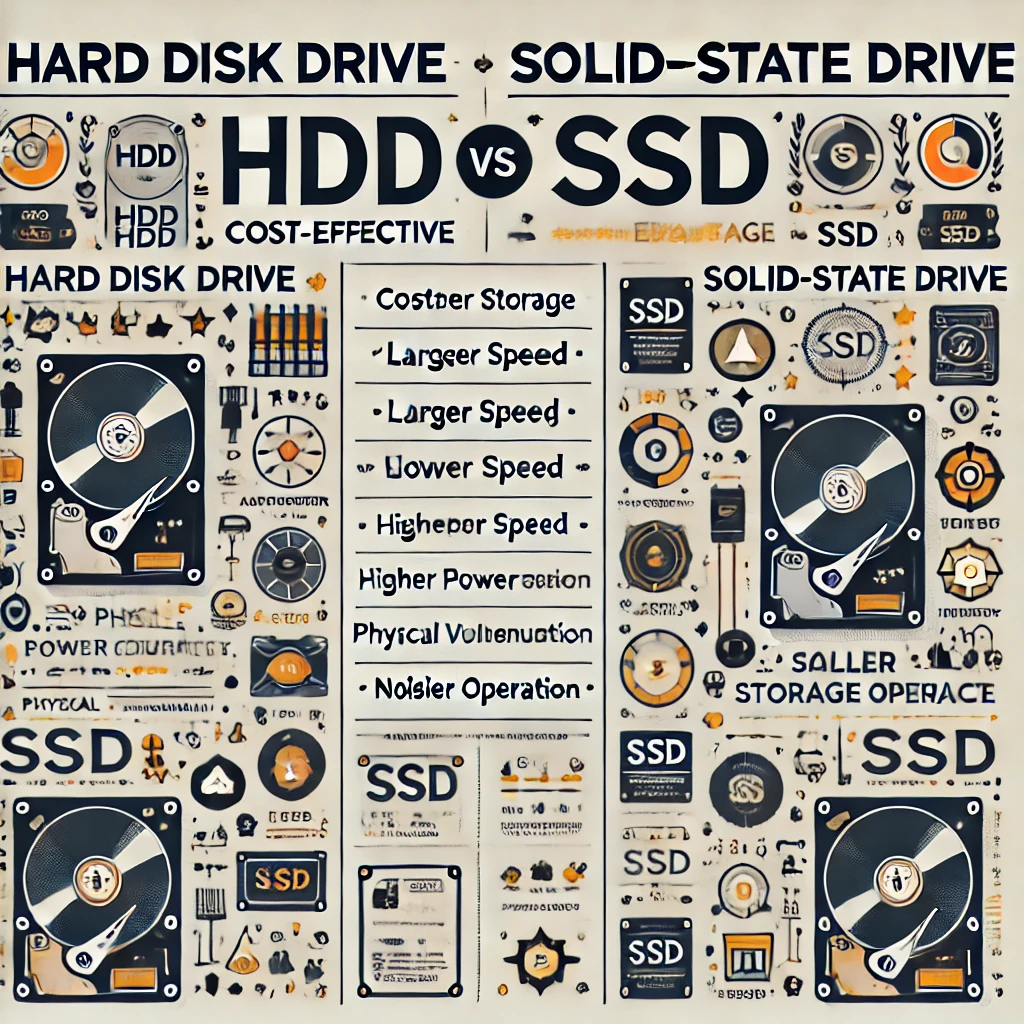
Here is the infographic comparing the advantages and disadvantages of both Hard Disk Drives (HDD) and Solid-State Drives (SSD). It visually summarizes the key points of each storage device for a clearer understanding.