Dr. Meyer is known for his difficult pop quizzes. Typically, before he conducts a pop quiz for his students, he shuts the classroom door. Students soon learn to anticipate a pop quiz whenever Dr. Meyer closes the classroom door. In this case, closing the door has become a(n)
a.) unconditioned stimulus (US).
b.) conditioned stimulus (CS).
c.) unconditioned response (UR).
The correct answer and explanation is :
The correct answer is:
b.) conditioned stimulus (CS).
Explanation:
In classical conditioning, a conditioned stimulus (CS) is a previously neutral stimulus that, after being repeatedly associated with an unconditioned stimulus (US), triggers a conditioned response (CR).
In this scenario:
- Dr. Meyer’s pop quizzes act as the unconditioned stimulus (US) because they naturally cause anxiety or stress in students.
- The students’ reaction of stress or preparedness when they anticipate the quiz is the conditioned response (CR).
- Closing the classroom door, which was initially a neutral action, has now become the conditioned stimulus (CS) because students have learned to associate it with the pop quiz.
At first, when Dr. Meyer closed the door, students had no particular reaction. However, after repeatedly experiencing pop quizzes immediately after the door was shut, they began to associate the two events. Eventually, just the act of closing the door—without an actual quiz—can trigger anxiety or heightened alertness in students, demonstrating classical conditioning in action.
This is similar to Ivan Pavlov’s experiment with dogs, where he rang a bell (neutral stimulus) before feeding them. Over time, the dogs associated the bell with food and began salivating at the sound alone, even without food being present. Here, the closing of the door plays the same role as the bell in Pavlov’s experiment—it triggers a learned response.
This example highlights how people form associations between seemingly unrelated events, a fundamental principle of learning psychology.
Image:
I’ll generate an image illustrating the concept of classical conditioning in this scenario.
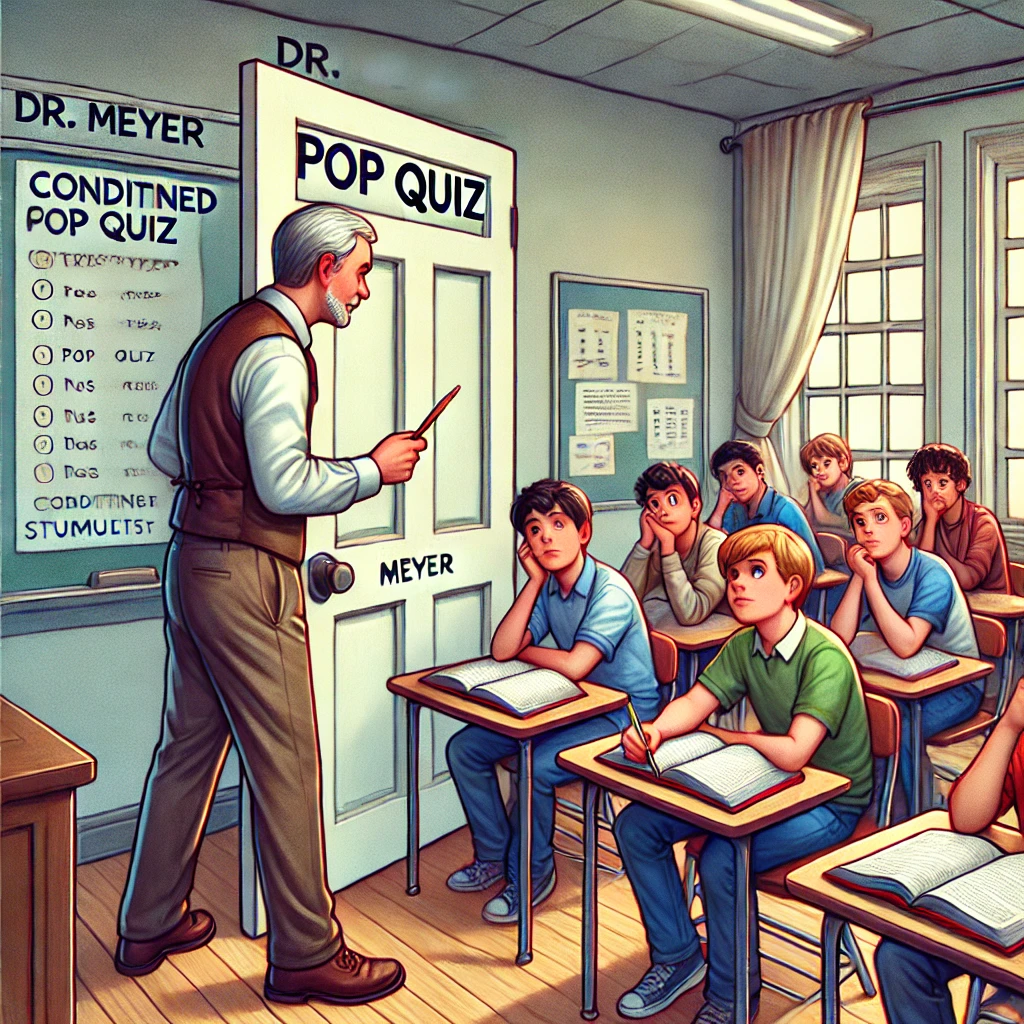
Here is an image illustrating the concept of classical conditioning in Dr. Meyer’s classroom. It visually represents the students’ anxious reaction as the teacher closes the door, anticipating a pop quiz.