How do atomic radius, ionization energy, and electron affinity change throughout the periodic table?
Predict: Based on your investigations in activities A and B, predict where in the periodic table you will typically find the following:
Largest atoms
Smallest atoms
Highest ionization energy
Lowest ionization energy
Highest electron affinity
Lowest electron affinity
Upper right region Upper left region Far right column Far left column Lower right region Lower left region
Observe: Choose Atomic radius from the drop-down menu to see the relative sizes of the elements. In which parts of the table do you find the largest and smallest atoms?
Observe: Choose ionization energy. Ionization energy is shown by color. In which parts of the table do you find atoms with the highest and the lowest ionization energies?
The correct answer and explanation is :
Answer:
- Largest Atoms – Found in the lower left region of the periodic table.
- Smallest Atoms – Found in the upper right region of the periodic table.
- Highest Ionization Energy – Found in the upper right region of the periodic table.
- Lowest Ionization Energy – Found in the lower left region of the periodic table.
- Highest Electron Affinity – Found in the upper right region, excluding noble gases.
- Lowest Electron Affinity – Found in the lower left region of the periodic table.
Explanation:
The periodic table is arranged in a way that allows scientists to predict the properties of elements based on their position. These properties, known as periodic trends, include atomic radius, ionization energy, and electron affinity.
- Atomic Radius
- Trend: Increases down a group (column) and decreases across a period (row) from left to right.
- Why? As you move down a group, additional electron shells increase the atom’s size. Across a period, the increasing nuclear charge pulls electrons closer, reducing the atomic size.
- Largest Atoms: Found in the lower left region (e.g., Francium, Cesium).
- Smallest Atoms: Found in the upper right region (e.g., Helium, Fluorine).
- Ionization Energy
- Trend: Increases across a period (left to right) and decreases down a group.
- Why? Atoms with a strong nuclear charge (right side of the table) hold their electrons tightly, requiring more energy to remove an electron.
- Highest Ionization Energy: Upper right region (e.g., Helium, Neon).
- Lowest Ionization Energy: Lower left region (e.g., Francium, Cesium).
- Electron Affinity
- Trend: Generally increases across a period and decreases down a group.
- Why? Atoms on the right side (except noble gases) strongly attract electrons to complete their valence shell.
- Highest Electron Affinity: Upper right region (e.g., Chlorine, Fluorine).
- Lowest Electron Affinity: Lower left region (e.g., Alkali metals like Cesium, Francium).
This pattern explains why elements on the left tend to lose electrons (metals), while elements on the right gain electrons (nonmetals).
Now, I’ll generate an image illustrating these trends.
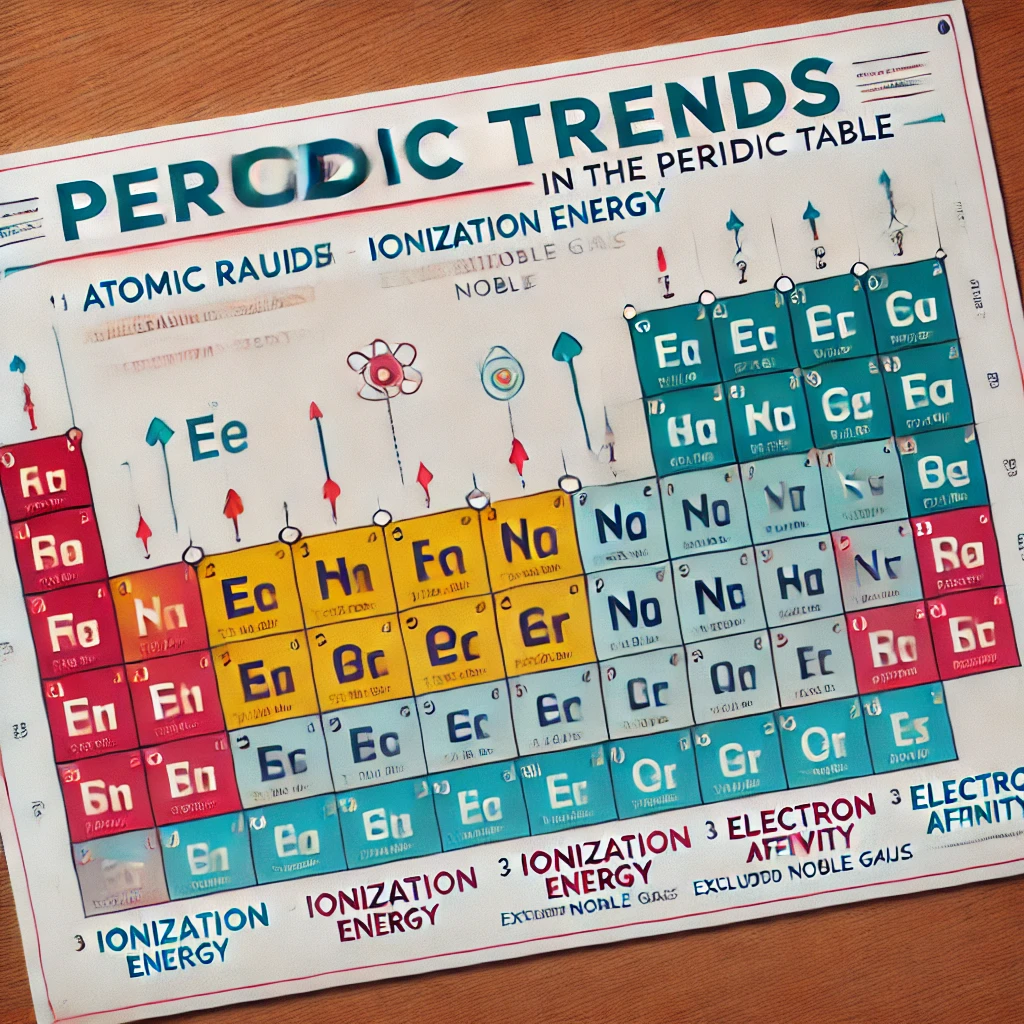
Here is an educational infographic illustrating periodic trends in the periodic table. It highlights the trends for atomic radius, ionization energy, and electron affinity with clear color-coded regions and directional arrows.