In contrast to insight-oriented therapies, behavior therapy focuses on:
A trying to modify and overhaul the person’s entire personality.
B developing an understanding of the unconscious conflicts that are causing the emotional, behavioral, and interpersonal difficulties.
C understanding how the dynamics of past relationships and feelings of inferiority have produced the current difficulties.
D unlearning maladaptive behaviors and acquiring more adaptive behaviors in their place.
The correct answer and explanation is :
Correct Answer: D – Unlearning maladaptive behaviors and acquiring more adaptive behaviors in their place.
Explanation:
Behavior therapy, also known as behavioral therapy, is a psychological treatment approach that focuses on modifying maladaptive behaviors through principles of learning, rather than delving into unconscious conflicts or personality changes. This therapy is grounded in the work of behaviorists such as B.F. Skinner, Ivan Pavlov, and John Watson, who emphasized that behaviors are learned and can be changed through conditioning.
Unlike insight-oriented therapies, such as psychoanalysis or psychodynamic therapy, which explore unconscious conflicts (answer B) or past relationship dynamics (answer C), behavior therapy concentrates on the present and practical ways to change negative behaviors. It does not aim to overhaul an individual’s entire personality (answer A) but instead focuses on specific problematic behaviors.
Behavior therapy uses techniques such as:
- Classical Conditioning: Associating a stimulus with a desired response, like in systematic desensitization for phobias.
- Operant Conditioning: Reinforcing positive behaviors and discouraging negative ones through rewards and punishments.
- Modeling and Social Learning: Observing and imitating appropriate behaviors.
- Cognitive-Behavioral Techniques: Challenging negative thoughts to encourage healthier behaviors.
By helping individuals unlearn harmful behaviors and replace them with adaptive ones, behavior therapy effectively treats conditions such as anxiety disorders, phobias, obsessive-compulsive disorder (OCD), and behavioral issues in children. It is a structured, goal-oriented approach that emphasizes measurable outcomes, making it highly effective for many psychological problems.
Now, I’ll generate an image representing behavior therapy.
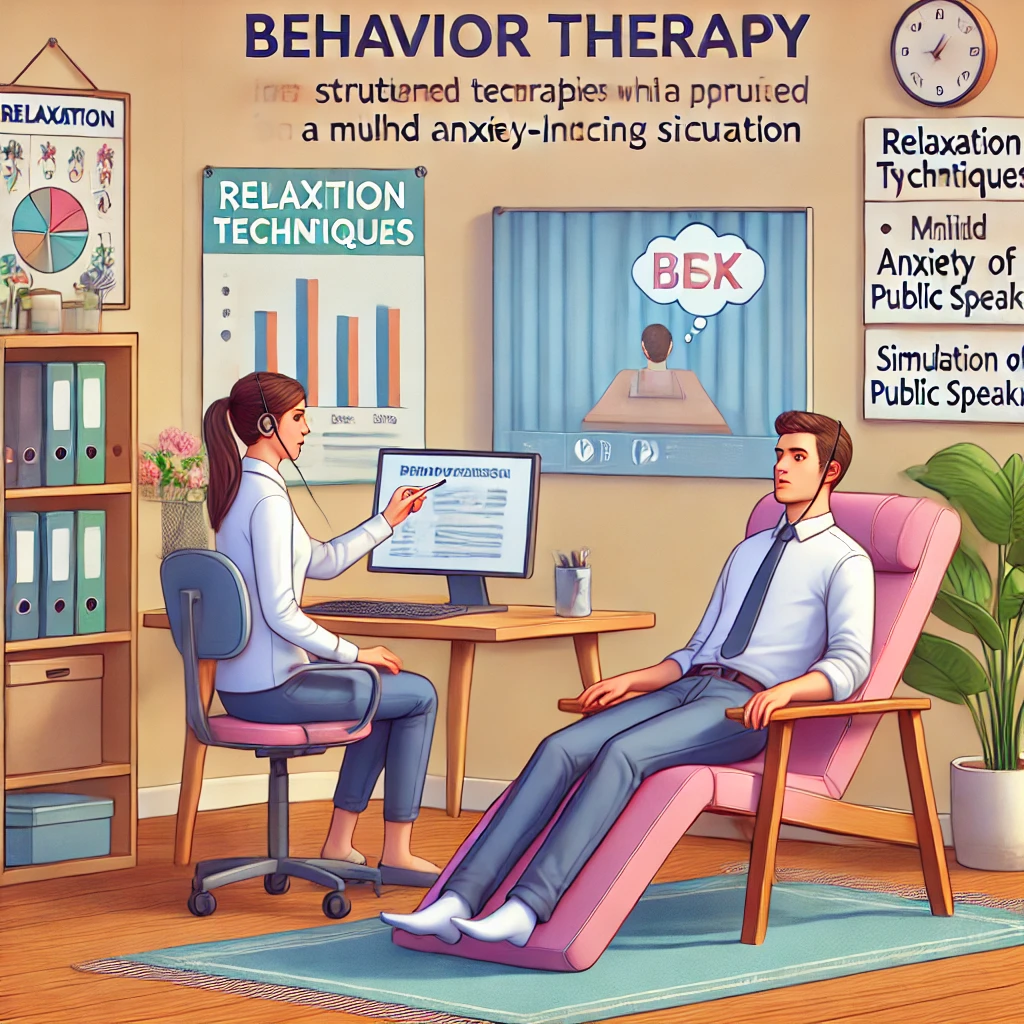
Here is an illustration representing behavior therapy in action. It visually depicts a therapist guiding a patient through a structured behavioral exercise in a calm therapy office setting.