The pelvic girdle consists of two 2. The head of the femur articulates with the of the hip bone. A 3. The is the largest portion of the hip bone. 4. The distance between the represents the shortest diameter of the pelvic outlet 5. The pubic bones come together anteriorly to form a cartilaginous joint called the 6. The is the portion of the ilium that causes the prominence of the hip 1 7. When a person sits, the of the schium supports the weight of the body 8. The angle formed by the puble bones helow the puble sympilysis is called the 9. The is the largest fonamento the skeleton. 10. The ilium joins the sacrum at the jom Match the bones in column A with the features in column B. Place the letter of your choice in the space provided. Column A Column B a. Femur 1. Middle phalanx b. Fibula 2. Lesser trochanter c. Metatarsals d. Patella 3. Medial malleolus e. Phalanges 4. Fovea capitis f. Tarsals 5. Calcaneus 6. Lateral cuneiform 7. Tibial tuberosity 8. Talus g. Tibia 9. Linea aspera 10. Lateral malleolus 11. Sesamoid bone 12. Five bones that form the instep HTML Edito Identify the bones and features indicated in the radiographs of figures 17.8-17.10. A A Terms: Head of femur llium Obturator foramen Pubic symphysis Pubis Sacrum bone) 2 3 o 10 Terms: Calcaneus Cuboid Distat phalanges Intermediate cuneiform Lateral cuneiform Mediat cuneiform Metatarsals ?
The correct answer and explanation is :
Here are the correct answers:
Fill in the blanks
- The pelvic girdle consists of two hip bones.
- The head of the femur articulates with the acetabulum of the hip bone.
- The ilium is the largest portion of the hip bone.
- The distance between the ischial spines represents the shortest diameter of the pelvic outlet.
- The pubic bones come together anteriorly to form a cartilaginous joint called the pubic symphysis.
- The iliac crest is the portion of the ilium that causes the prominence of the hip.
- When a person sits, the ischial tuberosity of the ischium supports the weight of the body.
- The angle formed by the pubic bones below the pubic symphysis is called the subpubic angle.
- The femur is the largest bone in the skeleton.
- The ilium joins the sacrum at the sacroiliac joint.
Matching Column A with Column B
| Column A | Column B |
|---|---|
| a. Femur | 2. Lesser trochanter |
| b. Fibula | 10. Lateral malleolus |
| c. Metatarsals | 12. Five bones that form the instep |
| d. Patella | 11. Sesamoid bone |
| e. Phalanges | 1. Middle phalanx |
| f. Tarsals | 6. Lateral cuneiform |
| g. Tibia | 3. Medial malleolus |
Explanation (300 words)
The pelvic girdle is composed of two hip bones, each formed by three fused bones: ilium, ischium, and pubis. These bones provide structural support, protect internal organs, and serve as attachment points for muscles. The head of the femur articulates with the acetabulum, forming the hip joint, which allows for a wide range of movements.
The ilium is the largest part of the hip bone and contains the iliac crest, which is the uppermost, curved part of the pelvis, giving the hip prominence. The ischial tuberosities, found on the lower part of the ischium, support body weight when sitting. The pubic symphysis is a cartilaginous joint that connects the left and right pubic bones, allowing slight movement to absorb shock. The subpubic angle differs in males and females, being wider in females for childbirth.
The femur is the longest and strongest bone in the human body. Its lesser trochanter serves as an attachment for hip muscles. The tibia and fibula are lower leg bones; the tibia is larger and bears most of the weight, while the fibula supports muscle attachment. The medial malleolus (on the tibia) and lateral malleolus (on the fibula) form the ankle joint.
The foot contains metatarsals, phalanges, and tarsal bones, including the calcaneus (heel bone), talus, and three cuneiform bones. These bones help support weight and aid in balance and movement.
Now, I’ll generate an image illustrating these anatomical features.
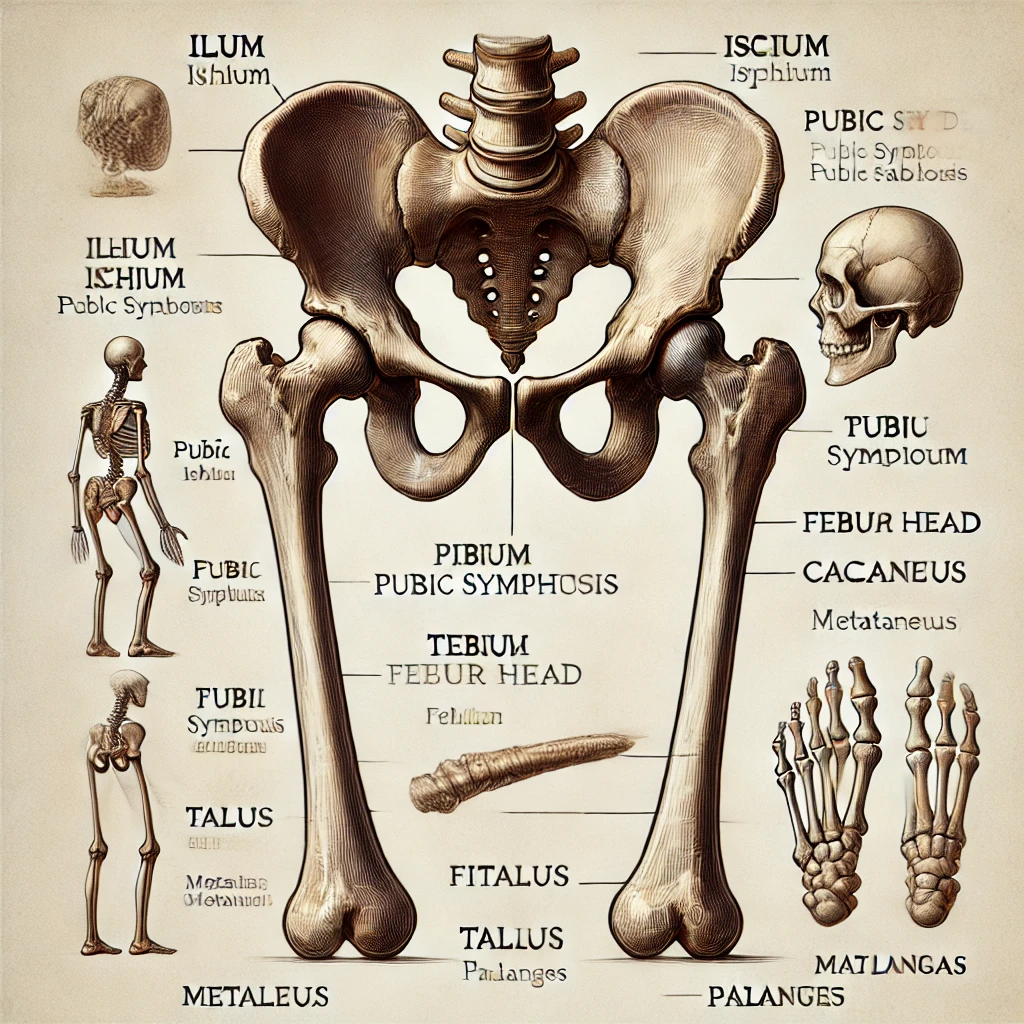
I have generated an anatomical diagram illustrating the human pelvis, femur, tibia, fibula, and foot bones with labeled key features.