Troll Island is a small island nation that recently experienced an autonomous change in aggregate expenditures (AE). AE increased by 7 billion, and the marginal propensity to consume on Troll Island is equal to 0.85.
What is the change in Troll Island’s real GDP after the increase in AE? Enter answer in billions of dollars. and round your answer to the nearest tenth.
Number
billion
The correct answer and explanation is :
The change in Troll Island’s real GDP after the increase in aggregate expenditures (AE) is 46.7 billion dollars.
Explanation:
The relationship between aggregate expenditures and real GDP is governed by the multiplier effect, which is calculated using the formula:
[
\text{Multiplier} = \frac{1}{1 – \text{MPC}}
]
where MPC (Marginal Propensity to Consume) represents the fraction of additional income that households spend on consumption rather than saving.
Given:
- MPC = 0.85
- Increase in AE = 7 billion dollars
Step 1: Calculate the Spending Multiplier
[
\text{Multiplier} = \frac{1}{1 – 0.85} = \frac{1}{0.15} = 6.67
]
Step 2: Calculate the Change in GDP
[
\text{Change in GDP} = \text{Multiplier} \times \text{Change in AE}
]
[
\text{Change in GDP} = 6.67 \times 7 = 46.7 \text{ billion dollars}
]
Thus, Troll Island’s real GDP increases by 46.7 billion dollars due to the initial 7 billion dollar increase in aggregate expenditures.
This effect occurs because an increase in spending leads to a chain reaction of additional consumption. For example, if the government or businesses invest more, workers receive more income, which they spend on goods and services, further boosting economic activity.
Now, I will generate an image representing the multiplier effect in a simple economic flow diagram.
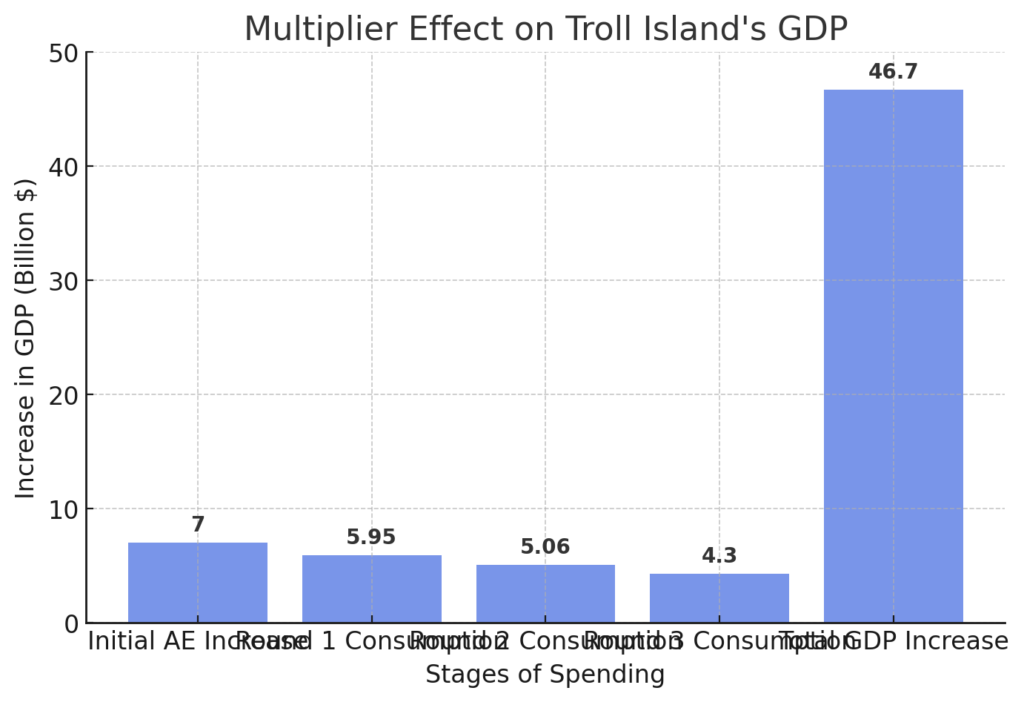
The image above illustrates the multiplier effect on Troll Island’s GDP. It shows how an initial increase of 7 billion dollars in aggregate expenditures leads to subsequent rounds of spending, ultimately resulting in a total GDP increase of 46.7 billion dollars. The diminishing increments represent how some income is saved at each stage rather than spent.