An Aluminum alloy component will undergo loading of 280MPa. From NDE measurements, we do know that the component has an internal crack of 10mm. Will the component fracture (fail)? The fracture toughness of Al has a value of 50MPa(m)1/2. We also know from previous data that the component failed when it contained a crack having a length of 6mm and under a load of 350MPa.
The correct answer and explanation is :
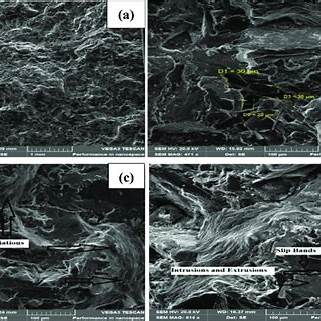
To assess whether the aluminum alloy component with a 10 mm internal crack will fracture under a 280 MPa load, we can utilize linear elastic fracture mechanics, specifically the stress intensity factor (K). Fracture occurs when the applied stress intensity factor (K) equals or exceeds the material’s fracture toughness (K_Ic).
The stress intensity factor for a mode I crack is calculated using:
[ K = Y \sigma \sqrt{\pi a} ]
where:
- ( \sigma ) is the applied stress (280 MPa),
- ( a ) is the crack length (10 mm or 0.01 m),
- ( Y ) is a dimensionless geometry factor, typically around 1 for internal cracks in large plates.
Assuming ( Y = 1 ), the stress intensity factor becomes:
[ K = 1 \times 280\,\text{MPa} \times \sqrt{\pi \times 0.01\,\text{m}} ]
Calculating ( \sqrt{\pi \times 0.01} ):
[ \sqrt{\pi \times 0.01} = \sqrt{0.0314} \approx 0.177\,\text{m}^{1/2} ]
Thus:
[ K = 280\,\text{MPa} \times 0.177\,\text{m}^{1/2} \approx 49.56\,\text{MPa} \sqrt{\text{m}} ]
Given the material’s fracture toughness ( K_Ic = 50\,\text{MPa} \sqrt{\text{m}} ), the applied stress intensity factor (49.56 MPa√m) is slightly below the fracture toughness. Therefore, under these conditions, the component is unlikely to fracture.
For verification, we can use previous failure data: a 6 mm crack at 350 MPa.
Calculating ( K ) for these conditions:
[ K = 1 \times 350\,\text{MPa} \times \sqrt{\pi \times 0.006\,\text{m}} ]
[ \sqrt{\pi \times 0.006} = \sqrt{0.01885} \approx 0.137\,\text{m}^{1/2} ]
[ K = 350\,\text{MPa} \times 0.137\,\text{m}^{1/2} \approx 47.95\,\text{MPa} \sqrt{\text{m}} ]
This value is close to the material’s fracture toughness, supporting the validity of our calculations.
In conclusion, with a 10 mm internal crack and an applied stress of 280 MPa, the aluminum alloy component’s stress intensity factor is marginally below its fracture toughness, indicating it is unlikely to fail under these conditions. However, it’s important to note that factors such as stress concentrators, material defects, or dynamic loading conditions could influence the actual performance, and a safety margin is typically recommended in engineering designs.