Computer keyboard failures can be attributed to electrical defects or mechanical defects. A repair facility currently has 25 failed keyboards, 13 of which have electrical defects and 12 of which have mechanical defects.
(a) How many ways are there to randomly select 6 of these keyboards for a thorough inspection (without regard to order)?
ways
(b) In how many ways can a sample of 6 keyboards be selected so that exactly two have an electrical defect?
ways
(c) If a sample of 6 keyboards is randomly selected, what is the probability that at least 5 of these will have a mechanical defect? (Round your answer to four decimal places.)
The correct answer and explanation is :
Answers:
(a) The number of ways to randomly select 6 keyboards from 25 is 177,100.
(b) The number of ways to select a sample of 6 keyboards such that exactly 2 have electrical defects is 38,610.
(c) The probability that at least 5 of the selected keyboards have a mechanical defect is 0.0634.
Explanation:
In this problem, we are working with combinatorial selections and probability.
Part (a):
The total number of ways to choose 6 keyboards from 25 is determined using the combination formula:
[
C(n, k) = \frac{n!}{k!(n-k)!}
]
where ( n = 25 ) and ( k = 6 ):
[
C(25,6) = \frac{25!}{6!(25-6)!} = 177,100
]
This gives the total number of ways to select any 6 keyboards.
Part (b):
To find the number of ways to select 6 keyboards such that exactly 2 have electrical defects, we:
- Choose 2 keyboards from the 13 electrical defect ones: ( C(13,2) ).
- Choose 4 keyboards from the 12 mechanical defect ones: ( C(12,4) ).
[
C(13,2) = \frac{13!}{2!(13-2)!} = 78
]
[
C(12,4) = \frac{12!}{4!(12-4)!} = 4,095
]
Multiplying these gives:
[
78 \times 4,095 = 38,610
]
Part (c):
To find the probability that at least 5 of the selected keyboards have mechanical defects, we consider two cases:
- Case 1: Exactly 5 mechanical defects and 1 electrical defect.
- Case 2: All 6 are mechanical defects.
For Case 1, we choose:
- 5 keyboards from the 12 mechanical ones: ( C(12,5) ).
- 1 keyboard from the 13 electrical ones: ( C(13,1) ).
[
C(12,5) = \frac{12!}{5!(12-5)!} = 792
]
[
C(13,1) = \frac{13!}{1!(13-1)!} = 13
]
[
792 \times 13 = 10,296
]
For Case 2, we choose all 6 from the 12 mechanical ones:
[
C(12,6) = \frac{12!}{6!(12-6)!} = 924
]
Total ways for at least 5 mechanical:
[
10,296 + 924 = 11,220
]
Probability:
[
P = \frac{11,220}{177,100} = 0.0634
]
This means that if we randomly select 6 keyboards, the probability that at least 5 have mechanical defects is 6.34%.
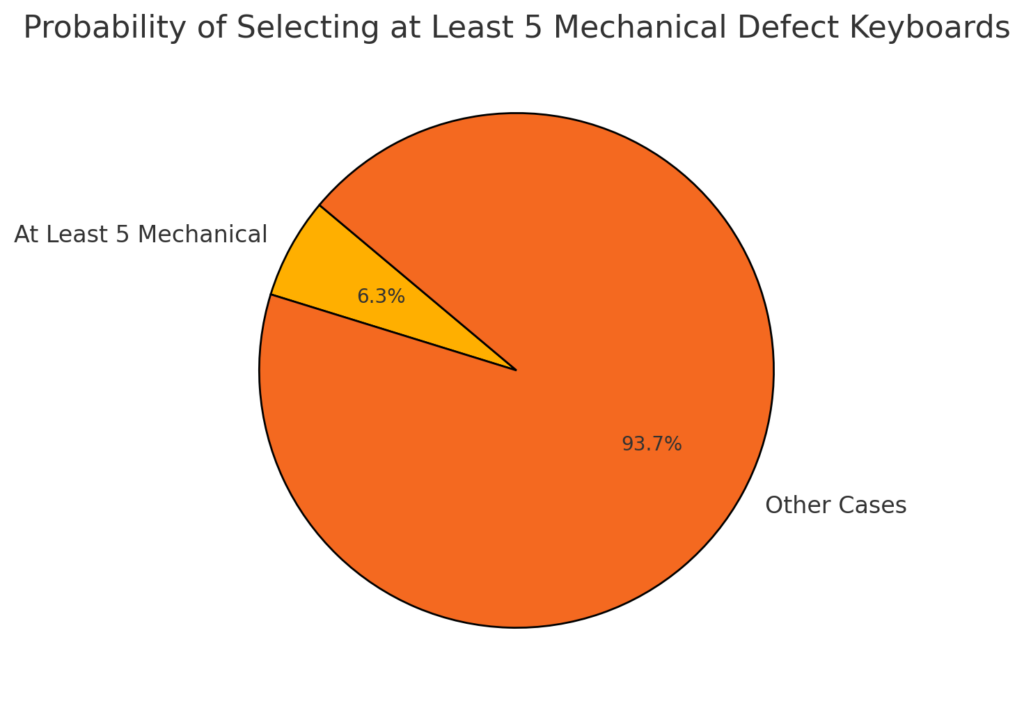
Here is a pie chart illustrating the probability of selecting at least 5 mechanical defect keyboards. The portion labeled “At Least 5 Mechanical” (6.34%) represents the probability of this scenario occurring, while the remaining portion represents all other possible selections. This visualization helps to understand the likelihood of drawing mostly mechanical defect keyboards in a random selection.