Design a digital system whose output is defined as logically low. If the 4 bit inpur binary number is a multiple of 3. Otherwise, the output will be logically high. The output is defined if and only if the input binary number is greater than 2
Design of a Digital System for Multiples of 3 Detection
Problem Statement:
We need to design a digital system that outputs a logically low (0) when a 4-bit input binary number is a multiple of 3. Otherwise, the output should be logically high (1). Additionally, the output should only be defined if the input number is greater than 2.
Step 1: Identifying Multiples of 3 in 4-bit Binary
A 4-bit binary input ranges from 0000 (0) to 1111 (15). However, we only consider numbers greater than 2 (i.e., from 3 to 15). The multiples of 3 in this range are:
- 3 (0011)
- 6 (0110)
- 9 (1001)
- 12 (1100)
- 15 (1111)
For these inputs, the output should be low (0). For all other numbers, the output should be high (1).
Step 2: Karnaugh Map (K-Map) for Optimization
Using a 4-variable Karnaugh map (K-map), we map the outputs for inputs 3 to 15.
| AB/CD | 00 | 01 | 10 | 11 |
|---|---|---|---|---|
| 00 | X | X | 1 | 0 |
| 01 | 1 | 0 | 1 | 1 |
| 10 | 0 | 1 | 1 | X |
| 11 | 0 | X | X | X |
Where X indicates an undefined condition (input < 3).
The minimized Boolean equation for the output (Y) is:
[
Y = \overline{(A \oplus B)C + \overline{B}D}
]
Step 3: Logic Circuit Design
Using the equation derived, the digital system can be designed using XOR gates, AND gates, and NOT gates.
Final Design
- Input: 4-bit binary (A, B, C, D)
- Output: Y (0 if multiple of 3, 1 otherwise)
- Components Used: XOR gates, AND gates, NOT gates
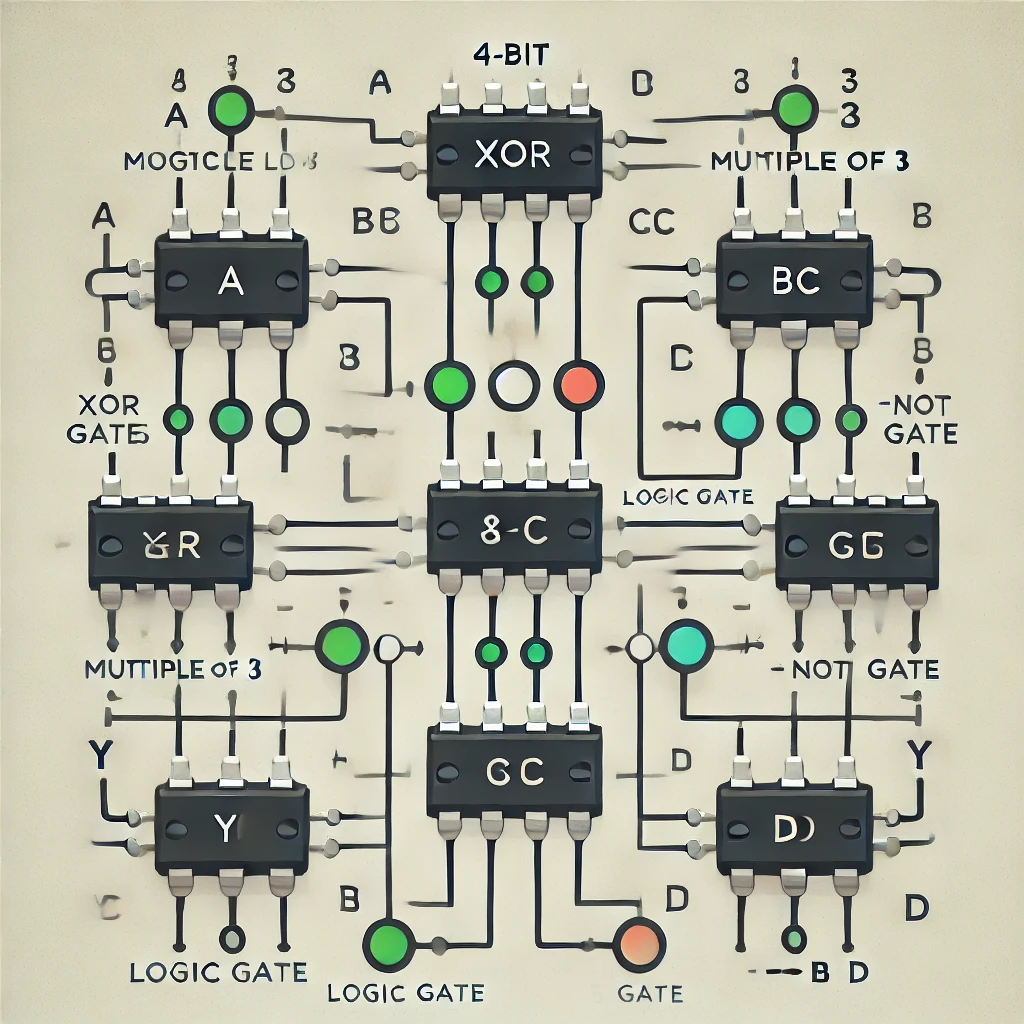
Here is the digital logic circuit diagram that detects multiples of 3 for a 4-bit binary input. The circuit follows the equation:
[
Y = \overline{(A \oplus B)C + \overline{B}D}
]
The output is logically low (0) when the input is a multiple of 3 and logically high (1) otherwise.