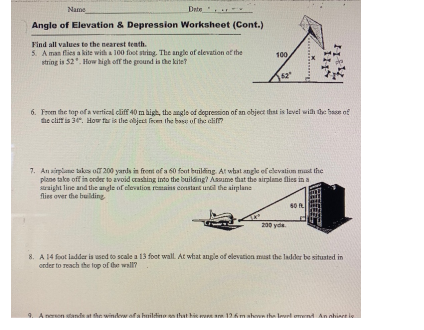
Name Date Angle of Elevation & Depression Worksheet (Cont.) Find all values to the nearest tenth. 5. A man
The correct answer and explanation is:
To solve the problem of a man flying a kite with 100 feet of string at an angle of elevation of 52°, we can determine the height of the kite above the ground and the horizontal distance from the man to the point directly beneath the kite using trigonometric principles.
Calculating the Height of the Kite:
The height (opposite side) of the kite can be found using the sine function in trigonometry, which relates the angle of elevation to the ratio of the opposite side over the hypotenuse:
sin(θ)=oppositehypotenuse\sin(\theta) = \frac{\text{opposite}}{\text{hypotenuse}}
Given:
- Angle of elevation, θ=52∘\theta = 52^\circ
- Length of the string (hypotenuse), hypotenuse=100\text{hypotenuse} = 100 feet
Rearranging the sine formula to solve for the opposite side (height):
opposite=sin(52∘)×100\text{opposite} = \sin(52^\circ) \times 100
Using a calculator:
sin(52∘)≈0.7880\sin(52^\circ) \approx 0.7880
Therefore:
opposite=0.7880×100=78.8 feet\text{opposite} = 0.7880 \times 100 = 78.8 \text{ feet}
So, the kite is approximately 78.8 feet above the man’s hand.
Calculating the Horizontal Distance from the Man to the Point Directly Beneath the Kite:
The horizontal distance (adjacent side) can be found using the cosine function:
cos(θ)=adjacenthypotenuse\cos(\theta) = \frac{\text{adjacent}}{\text{hypotenuse}}
Rearranging to solve for the adjacent side:
adjacent=cos(52∘)×100\text{adjacent} = \cos(52^\circ) \times 100
Using a calculator:
cos(52∘)≈0.6157\cos(52^\circ) \approx 0.6157
Therefore:
adjacent=0.6157×100=61.6 feet\text{adjacent} = 0.6157 \times 100 = 61.6 \text{ feet}
So, the horizontal distance from the man to the point directly beneath the kite is approximately 61.6 feet.
Explanation:
In problems involving angles of elevation and depression, right-angled triangles are often formed. The angle of elevation is the angle between the horizontal ground and the line of sight from the observer to an object above the horizontal. In this scenario, the man’s line of sight to the kite forms the hypotenuse of a right-angled triangle, with the height of the kite and the horizontal distance from the man to the point beneath the kite representing the opposite and adjacent sides, respectively.
By applying trigonometric ratios—sine for the opposite side and cosine for the adjacent side relative to the given angle—we can calculate the unknown lengths. These principles are fundamental in solving real-world problems involving heights and distances that cannot be measured directly.
For a visual explanation and additional practice on angles of elevation and depression, you may find the following video helpful:
videoTrigonometry Pt 3 – Angles of Elevation and Depressionturn0search6