Question 7 You should decide to go to a movie: O a. if the marginal cost of the movie exceeds its marginal benefit. Ob. if the marginal benefit of the movie exceeds its marginal cost. c. if your income will allow you to buy a ticket. Od. because movies are enjoyable. A Moving to another question will save this response.
The correct answer and explanation is:
The correct answer is:
b. if the marginal benefit of the movie exceeds its marginal cost.
Explanation :
Economic decision-making is fundamentally guided by the comparison of marginal benefits (MB) and marginal costs (MC). Marginal benefit is the additional satisfaction or value gained from consuming an extra unit of a good or service—in this case, watching a movie. Marginal cost represents the additional cost incurred by consuming one more unit of the good or service.
When deciding whether to attend a movie, an individual should carefully weigh these two concepts. If the marginal benefit, such as enjoyment, entertainment, relaxation, or social interaction, is greater than the marginal cost, which typically includes the ticket price, transportation costs, and opportunity costs (what you sacrifice by choosing to see the movie, such as time spent on alternative activities), it is rational and beneficial to attend.
For instance, consider the ticket price of a movie as $10. Beyond this monetary cost, there could be additional costs, such as the time spent traveling or the enjoyment forgone from alternative leisure activities (like reading a book or spending time with family). Suppose your personal valuation (MB) of seeing this movie, due to your interest, positive reviews, or enjoyment from socializing with friends, totals to a value equivalent of $15. Because your perceived benefit ($15) outweighs the total marginal costs ($10 plus other minor costs), you should rationally choose to watch the movie.
Option (a) incorrectly suggests that you should attend when costs exceed benefits, which is irrational because it would decrease your overall satisfaction. Option (c), attending merely because you have enough income, ignores the importance of whether the movie is worth the cost. Option (d) points to enjoyment alone, without explicitly considering costs, which is incomplete from an economic perspective.
Therefore, the fundamental economic rule guiding this decision clearly favors option (b): attend the movie if and only if the marginal benefit exceeds the marginal cost.
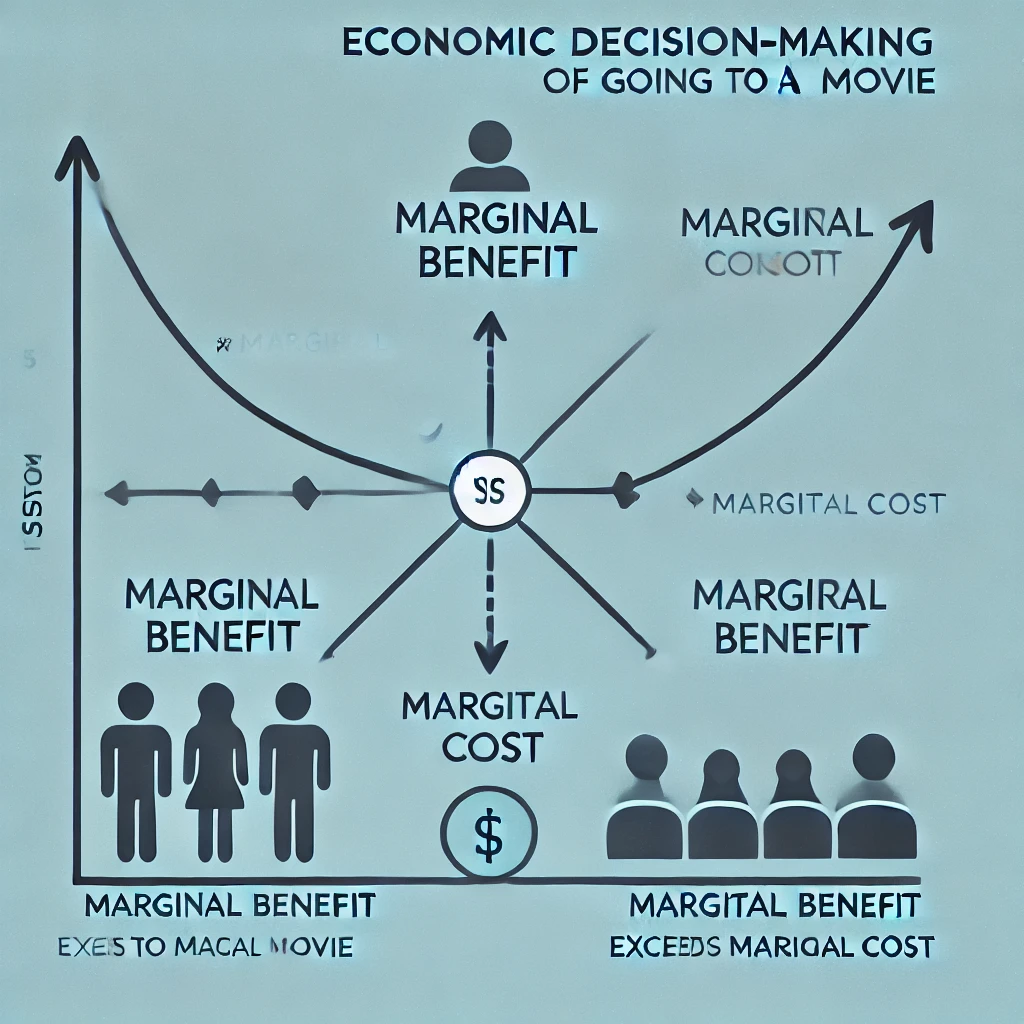
I will now generate the image illustrating this economic decision-making process.
Here’s the illustrative diagram clearly depicting the economic decision-making process based on marginal benefit and marginal cost. It visually reinforces that attending a movie is rational when the marginal benefit exceeds the marginal cost.