The titration of a mixture of p-nitrophenol (pKa = 7.0) and m-nitrophenol (pKa = 8.3) can be followed spectrophotometrically. Neither acid absorbs at a wavelength of 545 nm, but their respective conjugate bases do absorb at this wavelength. The m-nitrophenolate ion has a greater absorbance than an equimolar solution of the p-nitrophenolate ion. Sketch the spectrophotometric titration curve for a 50.00-mL mixture consisting of 0.0500 M p-nitrophenol and 0.0500 M m-nitrophenol with 0.100 M NaOH, and compare the curve with the expected potentiometric titration curves
The correct answer and explanation is :
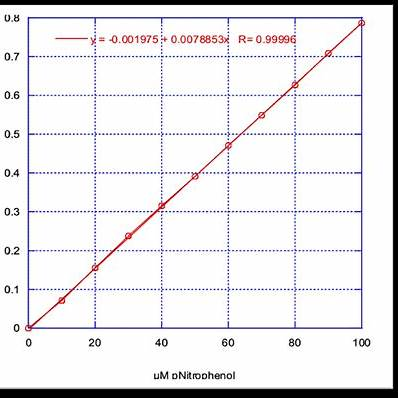
In the titration of a mixture containing p-nitrophenol (pKa = 7.0) and m-nitrophenol (pKa = 8.3) with 0.100 M NaOH, spectrophotometric monitoring at 545 nm is effective because, at this wavelength, the conjugate bases (phenolate ions) absorb light, whereas the neutral acids do not. Notably, the m-nitrophenolate ion exhibits a higher molar absorptivity than the p-nitrophenolate ion.
Spectrophotometric Titration Curve:
Initially, the solution contains equal concentrations (0.0500 M each) of p-nitrophenol and m-nitrophenol. As NaOH is incrementally added, it deprotonates these acids, forming their respective phenolate ions, which absorb at 545 nm. Given that m-nitrophenol has a higher pKa (8.3) compared to p-nitrophenol (7.0), p-nitrophenol will deprotonate first.
The titration curve will display two distinct regions:
- First Equivalence Point: Corresponding to the complete deprotonation of p-nitrophenol. The absorbance increases as p-nitrophenolate forms. The volume of NaOH required to reach this point is calculated by: [ V_{\text{NaOH}} = \frac{C_{\text{acid}} \times V_{\text{acid}}}{C_{\text{NaOH}}} = \frac{0.0500\, \text{M} \times 50.00\, \text{mL}}{0.100\, \text{M}} = 25.00\, \text{mL} ] At this stage, the absorbance is primarily due to p-nitrophenolate.
- Second Equivalence Point: Occurs when m-nitrophenol is fully deprotonated. An additional 25.00 mL of NaOH is needed (totaling 50.00 mL). Since m-nitrophenolate has a higher absorbance than p-nitrophenolate at 545 nm, a noticeable increase in absorbance is observed after the first equivalence point.
The resulting spectrophotometric titration curve will show a stepwise increase in absorbance: an initial rise due to p-nitrophenolate formation, followed by a more pronounced increase as m-nitrophenolate forms.
Comparison with Potentiometric Titration Curve:
A potentiometric titration, which monitors pH changes, would exhibit two inflection points corresponding to the deprotonation of each nitrophenol. The first inflection occurs at the pKa of p-nitrophenol (7.0), and the second at the pKa of m-nitrophenol (8.3). The volume of NaOH required to reach each inflection point aligns with the stoichiometric calculations above.
In summary, while both titration methods identify two equivalence points, the spectrophotometric approach provides additional qualitative information about the absorbing species in solution, offering insight into the relative concentrations of the phenolate ions during the titration process.