Which statement describes the reaction for cellular respiration?
The equation is carbon dioxide + water ? glucose + oxygen + water and energy is required in the form of light.
The equation is glucose + oxygen ? carbon dioxide + water and energy is produced in the form of ATP.
The equation is carbon dioxide + water ? glucose + oxygen + water and energy is produced in the form of ATP.
The equation is glucose + oxygen ? carbon dioxide + water and energy is required in the form of light.
The correct answer and explanation is:
The correct answer is:
The equation is glucose + oxygen → carbon dioxide + water and energy is produced in the form of ATP.
Explanation:
Cellular respiration is a biological process that occurs in the cells of organisms to generate energy. It primarily takes place in the mitochondria and is essential for sustaining life. The overall chemical equation for cellular respiration is: C6H12O6+6O2→6CO2+6H2O+ATPC_6H_{12}O_6 + 6O_2 → 6CO_2 + 6H_2O + ATP
This equation describes how glucose (C₆H₁₂O₆) and oxygen (O₂) are used to produce carbon dioxide (CO₂), water (H₂O), and adenosine triphosphate (ATP), which is the primary energy carrier in cells.
Step-by-Step Breakdown:
- Glycolysis (Occurs in the cytoplasm):
- One molecule of glucose is broken down into two molecules of pyruvate.
- A net gain of 2 ATP molecules is produced.
- NADH (electron carrier) is also generated.
- Krebs Cycle (Citric Acid Cycle) (Occurs in the mitochondria):
- Pyruvate is further broken down.
- Carbon dioxide (CO₂) is released as a waste product.
- NADH and FADH₂ (electron carriers) are produced.
- 2 ATP molecules are generated.
- Electron Transport Chain (ETC) (Occurs in the inner mitochondrial membrane):
- High-energy electrons from NADH and FADH₂ pass through a chain of proteins.
- Oxygen acts as the final electron acceptor and combines with hydrogen to form water (H₂O).
- This stage generates the most ATP (about 34 ATP molecules).
Importance of ATP:
ATP is crucial for cellular activities, including muscle contraction, nerve impulses, and active transport of molecules across cell membranes. Without cellular respiration, cells would not be able to generate the necessary energy for survival.
Now, I’ll generate an image representing cellular respiration.
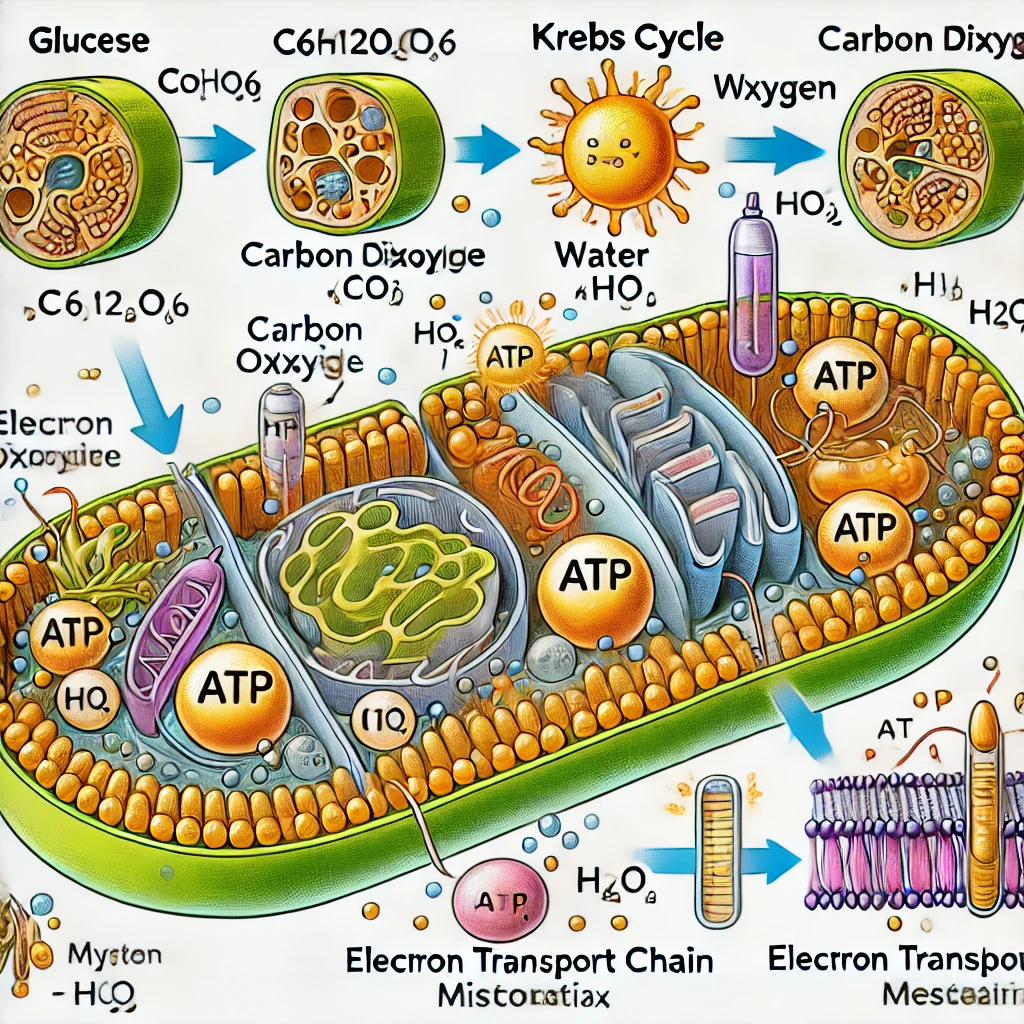
Here is the illustration of cellular respiration, depicting the stages of glycolysis, the Krebs cycle, and the electron transport chain within the mitochondria. Let me know if you need any modifications or further explanations!