Demand is along the upper half of a linear demand curve, so an increase in quantity from a decrease in price increases total revenue. Demand is along the lower half of a linear demand curve, so an increase in quantity from a decrease in price decreases total revenue. Total revenue is maximized at the midpoint of a linear demand curve, where demand is unit elastic.
The correct answer and explanation is :
The correct answer is:
Total revenue is maximized at the midpoint of a linear demand curve, where demand is unit elastic.
Explanation:
In economics, total revenue refers to the total income a firm receives from the sale of its goods or services. It is calculated by multiplying the price per unit by the quantity sold:
[
TR = P \times Q
]
The relationship between price, quantity, and total revenue on a demand curve can be analyzed using the concept of price elasticity of demand (PED), which measures how sensitive the quantity demanded is to a change in price.
- Elastic Demand (Price Elasticity > 1): In this region, a decrease in price leads to a proportionally larger increase in quantity demanded. As a result, total revenue increases.
- Inelastic Demand (Price Elasticity < 1): In this region, a decrease in price leads to a proportionally smaller increase in quantity demanded. As a result, total revenue decreases.
- Unit Elastic Demand (Price Elasticity = 1): This occurs at the midpoint of the demand curve. Here, a change in price leads to an exactly proportional change in quantity demanded, so total revenue remains constant.
The linear demand curve is typically characterized by the following behavior:
- Upper Half (Elastic Region): In this region, the demand is elastic. A decrease in price leads to a larger increase in quantity demanded, which increases total revenue.
- Lower Half (Inelastic Region): In this region, the demand is inelastic. A decrease in price leads to a smaller increase in quantity demanded, which decreases total revenue.
- Midpoint (Unit Elastic Region): This is the point where the demand curve is unit elastic, meaning that the percentage change in price equals the percentage change in quantity demanded. At this point, total revenue is maximized.
Thus, the total revenue is maximized at the midpoint of the linear demand curve, where demand is unit elastic.
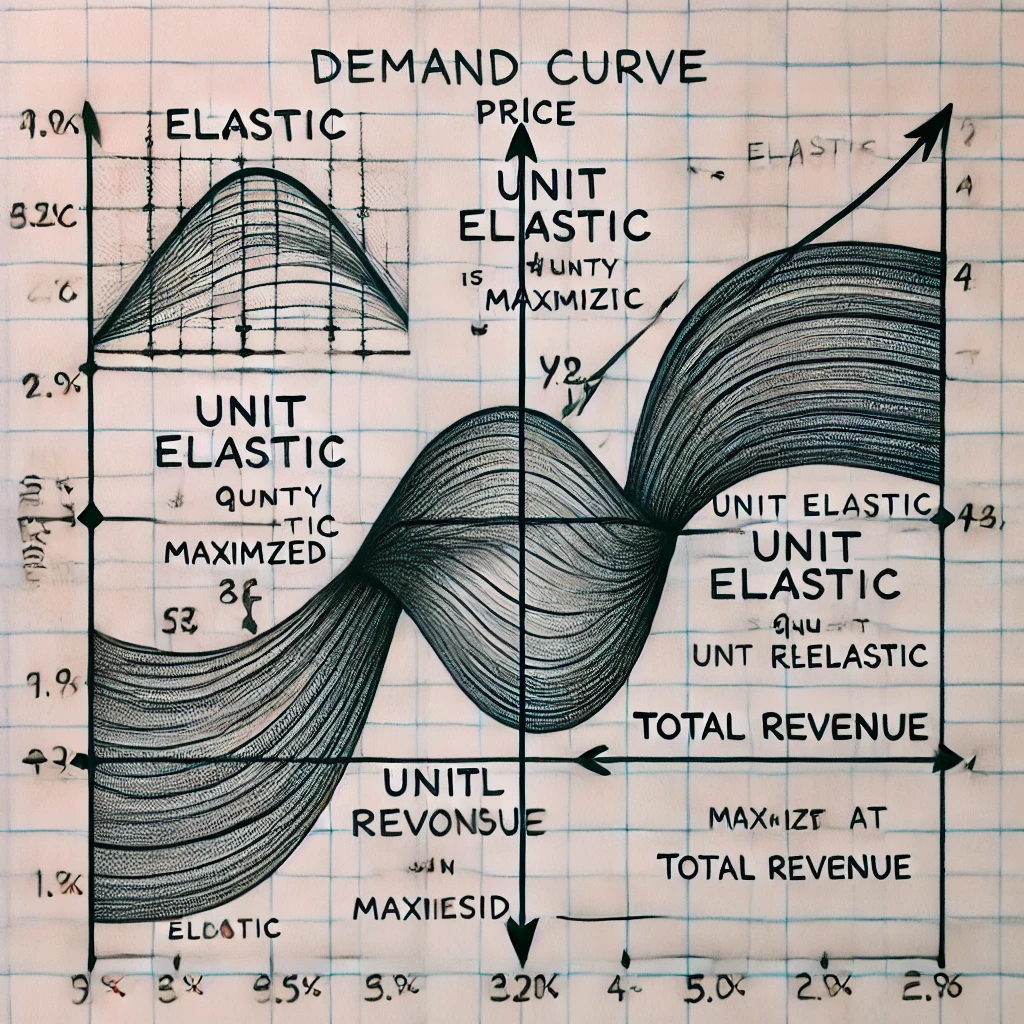
Here is the graphical representation of the linear demand curve showing the different regions: elastic, unit elastic, and inelastic. As you can see, total revenue is maximized at the midpoint of the curve, where the demand is unit elastic.
In the elastic region (upper half), a price decrease increases total revenue, while in the inelastic region (lower half), a price decrease decreases total revenue.