Explain the product life cycle theory and its implications for international trade. Analyse the evolution of specific products or industries in terms of this theory. Are there any industries where this theory may no longer hold true in today’s globalized economy?
The correct answer and explanation is :
The Product Life Cycle (PLC) theory, developed by Raymond Vernon in the 1960s, explains how a product’s production and sales evolve over time. The theory divides the life cycle of a product into four stages: introduction, growth, maturity, and decline. Initially, a new product is introduced in a developed economy (usually the country where it was invented) where innovation and production costs are higher. As the product gains market acceptance, production increases, and economies of scale bring costs down. Over time, competition rises, the product reaches maturity, and eventually, it may enter the decline stage due to technological advancements or changing consumer preferences.
Implications for International Trade:
The PLC theory suggests that in the early stages of a product’s life cycle, trade will flow from the innovating country to others. As production costs decrease and the product becomes standardized, manufacturing often shifts to lower-cost countries. Eventually, the product might be exported back to the original innovating country, and international trade becomes more balanced. This process highlights the dynamic nature of international trade and the shifting comparative advantage over time.
Evolution of Industries:
One example is the personal computer industry. In the 1980s, innovation was led by the United States, where computers were designed and manufactured. Over time, production shifted to countries like Taiwan and China as labor costs were lower, and the technology became more standardized. Now, the US imports these computers, even as companies continue to innovate.
Exceptions in Today’s Globalized Economy:
In today’s globalized world, the PLC theory may not fully apply to all industries. For example, in high-tech sectors like smartphones, the production and innovation stages are much more globally integrated, with design, manufacturing, and assembly occurring across different countries. Moreover, industries such as software and digital services can experience rapid and global distribution without the same cost constraints.
Image Prompt:
Illustration of the Product Life Cycle curve with stages labeled and arrows showing the flow of production and trade from one country to another over time.
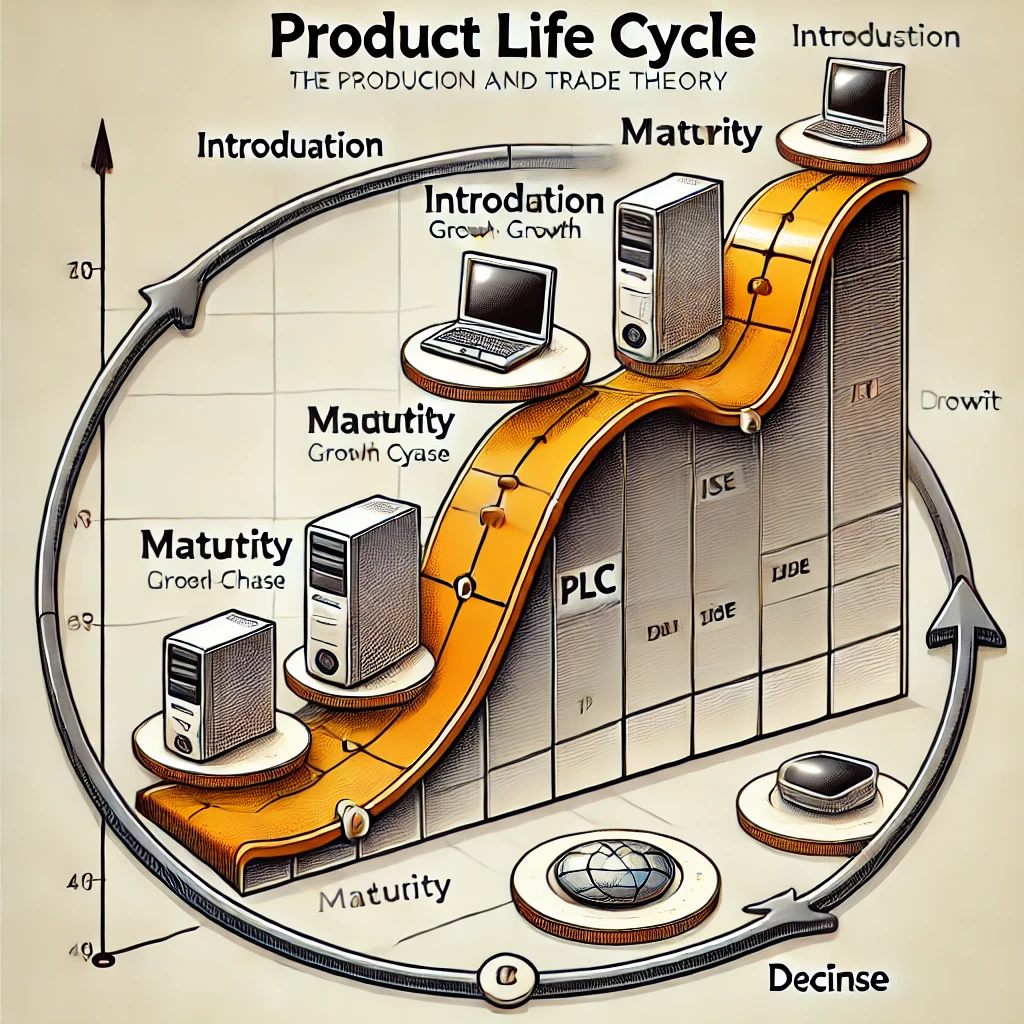
The image above illustrates the Product Life Cycle (PLC) theory, showing how a product evolves over time and how international trade and production shift through the different stages: introduction, growth, maturity, and decline. The arrows depict the global movement of production as costs decrease, leading to changes in trade patterns.