Give the conjugate acid and conjugate base of HSO3
A) H3SO3, SO32-
B) HSO3, HSO3-
C) H2SO3, SO32-
D) SO3, H2SO3
CE) HSO3, SO32-
The correct answer and explanation is :
The correct answer is:
C) H₂SO₃ (conjugate acid), SO₃²⁻ (conjugate base).
Explanation:
To determine the conjugate acid and conjugate base of HSO₃⁻, we need to understand the Brønsted-Lowry acid-base theory:
- Conjugate Acid: When a species gains a proton (( H^+ )), it forms its conjugate acid.
- Conjugate Base: When a species loses a proton (( H^+ )), it forms its conjugate base.
1. Finding the Conjugate Acid of HSO₃⁻
- To find the conjugate acid, we add a proton (( H^+ )) to HSO₃⁻:
[
HSO_3^- + H^+ \rightarrow H_2SO_3
] - The resulting species is H₂SO₃ (sulfurous acid), which is the conjugate acid of HSO₃⁻.
2. Finding the Conjugate Base of HSO₃⁻
- To find the conjugate base, we remove a proton (( H^+ )) from HSO₃⁻:
[
HSO_3^- \rightarrow SO_3^{2-} + H^+
] - The resulting species is SO₃²⁻ (sulfite ion), which is the conjugate base of HSO₃⁻.
Thus, the conjugate acid of HSO₃⁻ is H₂SO₃, and its conjugate base is SO₃²⁻.
Why the Other Options Are Incorrect:
- A) H₃SO₃ does not exist as a stable compound.
- B) HSO₃⁻ cannot be its own conjugate acid and conjugate base.
- D) SO₃ is not the correct conjugate base of HSO₃⁻.
- E) HSO₃ cannot be its own conjugate acid.
This confirms that option C is correct.
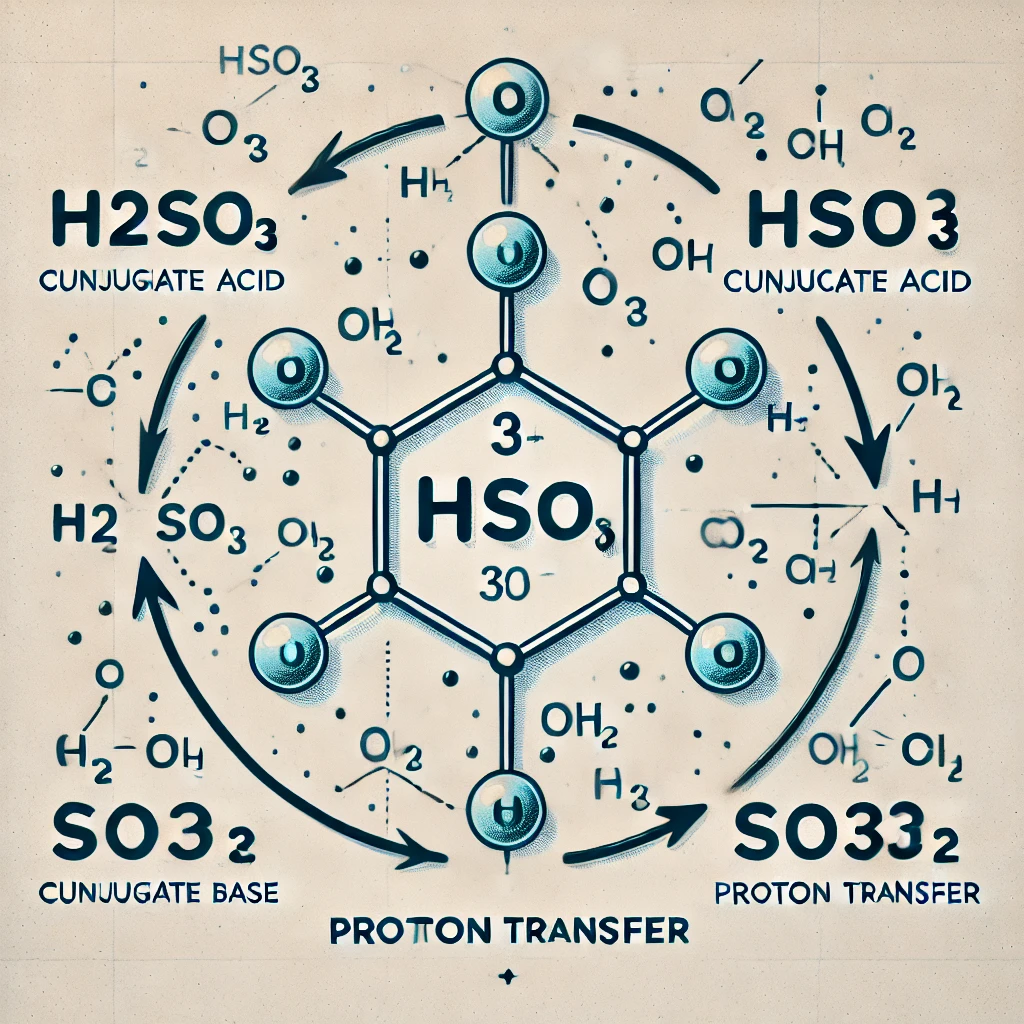
I’ve provided an image illustrating the conjugate acid-base relationship of HSO₃⁻. It visually represents how HSO₃⁻ transitions to its conjugate acid (H₂SO₃) and conjugate base (SO₃²⁻) through proton transfer.