Which of the following is needed for a rigid body to be in equilibrium?
(A) It must be stable.
(B) The net torque on it must be zero.
(C)The net force acting on it must be zero.
(D)The net force and the net torque acting on it must be zero.
The correct answer and explanation is :
The correct answer is (D) The net force and the net torque acting on it must be zero.
Explanation:
For a rigid body to be in equilibrium, two conditions must be met:
- The net force on the body must be zero: This condition ensures that the body does not experience any linear acceleration. When the vector sum of all the external forces acting on the body is zero, there will be no net force to move the body in any direction. Mathematically, this is expressed as:
[
\vec{F}_{\text{net}} = 0
]
If there were a non-zero net force, the body would accelerate according to Newton’s second law (( \vec{F} = m \cdot \vec{a} )). - The net torque on the body must be zero: This condition ensures that the body does not experience any angular acceleration. If the sum of all external torques (moments) acting on the body is zero, the body will not rotate or change its rotational motion. The net torque is calculated as:
[
\vec{\tau}_{\text{net}} = 0
]
If there were a non-zero net torque, the body would undergo angular acceleration according to the rotational analog of Newton’s second law (( \vec{\tau} = I \cdot \alpha )), where ( I ) is the moment of inertia and ( \alpha ) is the angular acceleration.
Thus, for a rigid body to be in a state of equilibrium, both of these conditions must be satisfied: no net force (no linear acceleration) and no net torque (no angular acceleration). This ensures that the body is in a state of rest or moving with constant velocity in a straight line (for translational equilibrium), and it does not rotate or has constant angular velocity (for rotational equilibrium).
Image Description:
The image will show a rigid body subjected to forces and torques, with illustrations of forces and moments acting on it. The vector sum of forces will be zero, and the sum of the torques will also be zero, indicating equilibrium.
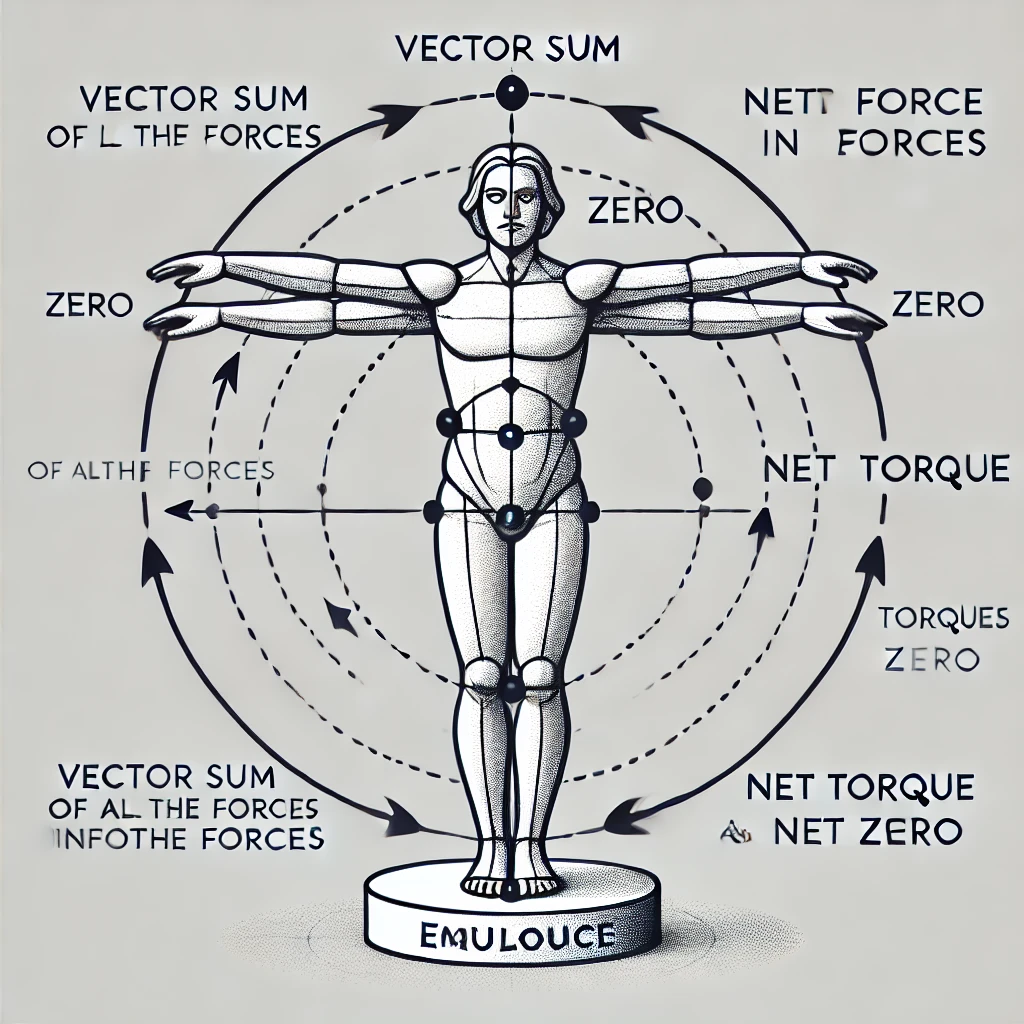
Here is the image illustrating a rigid body in equilibrium, with forces and torques acting on it, showing that both the net force and net torque are zero. This ensures that the body is not undergoing any linear or angular acceleration.