Which type of dam is constructed as a concrete or masonry wall across a valley?
A) Arch Dam
B) Gravity Dam
C) Embankment Dam
D) Buttress Dam
The correct answer and explanation is :
The correct answer is A) Arch Dam.
Explanation:
An Arch Dam is a type of dam that is constructed as a concrete or masonry wall across a narrow valley or gorge. This type of dam is designed to use its shape to transfer the water pressure to the canyon walls. The primary characteristic of an arch dam is its curved design, which allows it to be thinner than other types of dams, such as gravity dams, and it relies heavily on the natural strength of the canyon walls to support the structure.
Arch dams are ideal for locations where the valley or gorge has steep sides and narrow dimensions, as the arch shape allows the dam to be more efficient in withstanding the water pressure. The weight of the dam is much lower compared to gravity dams, as it doesn’t need to resist the pressure of the water through its own weight, but rather transfers it to the valley walls. This reduces the amount of material required and makes arch dams suitable for locations with limited space and materials.
In contrast, other types of dams include:
- Gravity Dam: This type of dam is made from concrete or masonry and relies on its own weight to resist the force of the water. It is typically used in wide valleys and is much thicker and heavier than an arch dam.
- Embankment Dam: This is a large dam made from earth or rock fill material. It is suitable for wide valleys and is designed to withstand water pressure through its mass.
- Buttress Dam: This dam features a sloped concrete surface supported by a series of buttresses (pillars), and it is also used for narrow valleys but requires more support than an arch dam.
Overall, arch dams are efficient, especially when building in narrow, steep terrains where a concrete structure can be supported by the natural features of the valley.
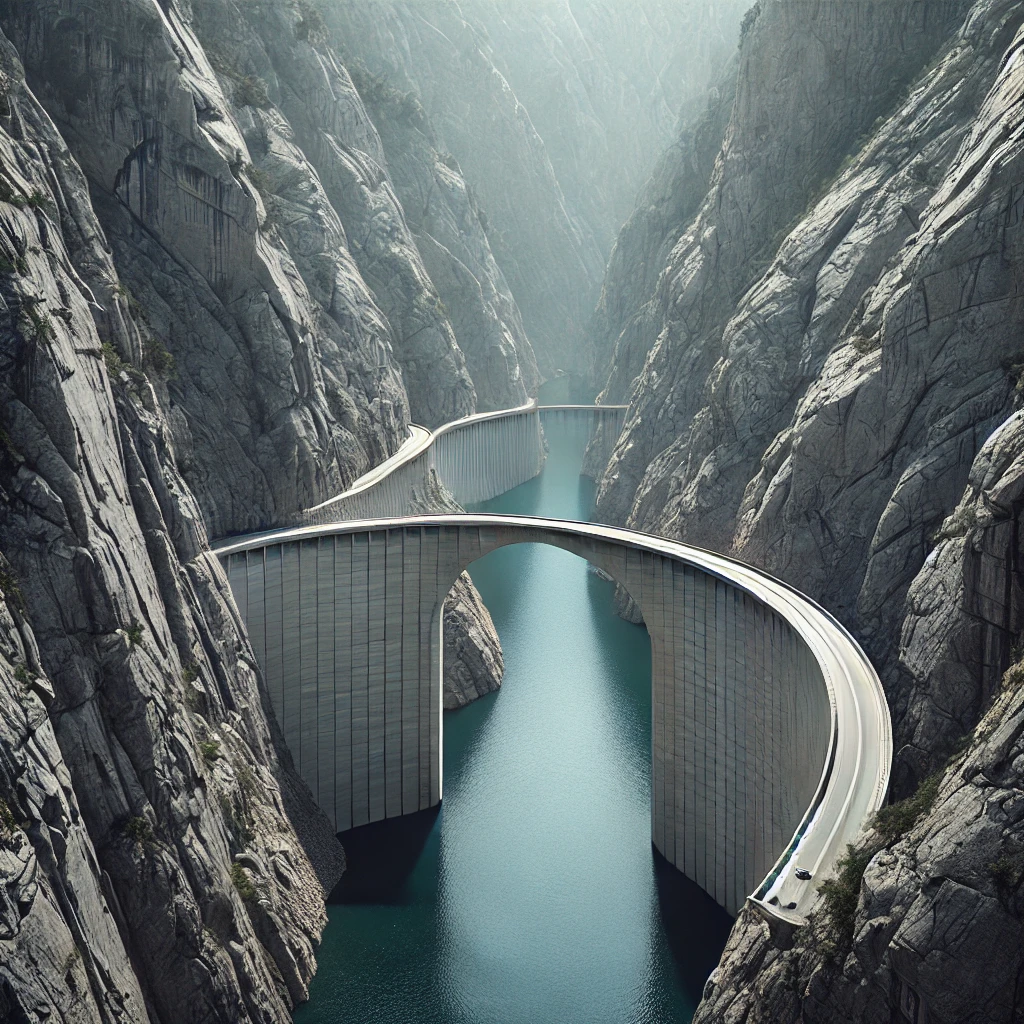
Here is an image of an arch dam, showcasing the concrete structure curving across a narrow valley. The dam relies on its shape to transfer water pressure to the canyon walls, making it efficient for such terrains.