Explain why knowledge of cost behavior is important for managerial decision making. Explain a driver and give an example of a cost and its corresponding output measure or driver. Explain the difference between committed and discretionary fixed costs and give examples of each.
The correct answer and explanation is :
Knowledge of Cost Behavior in Managerial Decision Making
Understanding cost behavior is crucial for managerial decision-making because it helps managers predict how costs will change with variations in production levels, sales volumes, or other business activities. Knowing whether costs are fixed, variable, or mixed allows managers to forecast costs accurately, set budgets, and make strategic decisions like pricing, production planning, and cost control. Cost behavior analysis aids in break-even analysis, which helps managers determine the level of sales needed to cover all costs and start making a profit.
Driver and Example
A cost driver is a factor that causes changes in the cost of an activity or production. It is used to explain the relationship between cost and the activity that drives it. An example of a cost driver is machine hours, which can drive the cost of maintenance for manufacturing equipment. If machine hours increase due to higher production, maintenance costs are likely to increase as well.
For instance, maintenance costs are driven by machine hours. If the number of hours machines operate increases, the cost of maintaining these machines will also rise. In this case, machine hours serve as the driver, and maintenance costs are the cost that changes with it.
Committed vs. Discretionary Fixed Costs
Fixed costs do not vary with production levels in the short term, but they can be categorized into committed and discretionary fixed costs.
- Committed Fixed Costs: These are costs that a company must incur regardless of its level of production. They typically relate to long-term investments or contractual obligations. Examples include depreciation on factory equipment and long-term lease payments for buildings. These costs are generally inflexible and cannot be easily altered in the short term.
- Discretionary Fixed Costs: These are costs that a company can adjust or eliminate based on its current priorities or budgetary constraints. Examples include advertising expenses or employee training programs. These costs are more flexible and can be adjusted or even eliminated if necessary.
Understanding these types of fixed costs allows managers to make better decisions regarding cost-cutting measures or investments.
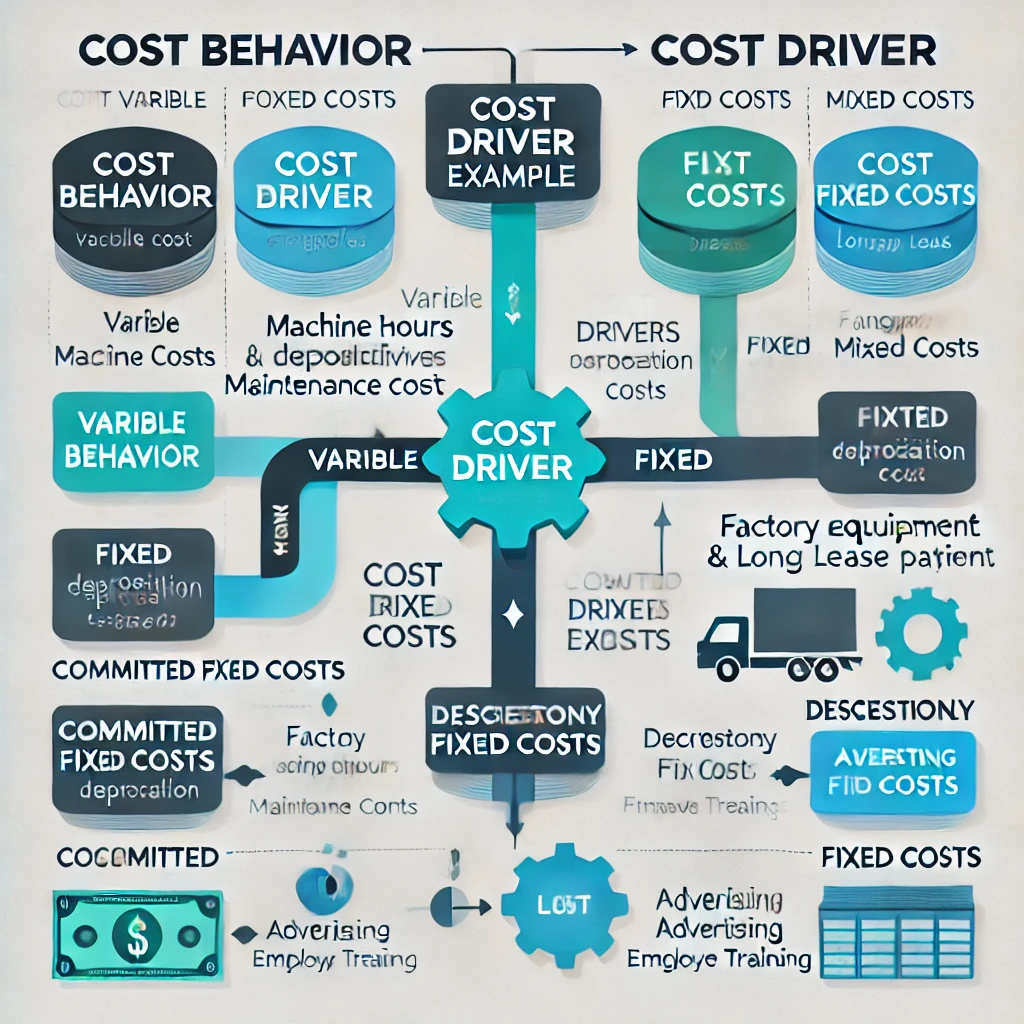
The image above illustrates the relationship between cost behavior, drivers, and fixed costs. It provides a clear view of how variable, fixed, and mixed costs are categorized and how cost drivers (like machine hours) affect costs like maintenance. It also distinguishes between committed and discretionary fixed costs, showing examples such as depreciation on equipment and advertising expenses.