The ion 39K+ has:
A. 18 electrons, 19 protons, 19 neutrons
B. 19 electrons, 19 protons, 39 neutrons
C. 18 electrons, 18 protons, 21 neutrons
D. 18 electrons, 19 protons, 20 neutrons
E. 19 electrons, 18 protons, 20 neutrons
The correct answer and explanation is :
The correct answer is D. 18 electrons, 19 protons, 20 neutrons.
Explanation:
The ion in question is ( K^+ ), which is a potassium ion with a positive charge. To understand the properties of this ion, we need to break it down:
- Protons:
Potassium (K) has an atomic number of 19. The atomic number of an element tells us the number of protons in an atom. Therefore, the potassium atom has 19 protons. - Electrons:
A neutral atom of potassium would have the same number of electrons as protons, so it would have 19 electrons. However, the potassium ion ( K^+ ) has a +1 charge, which means it has lost one electron. So, the potassium ion has 18 electrons (19 protons – 1 electron). - Neutrons:
The number of neutrons in an atom is found by subtracting the atomic number (protons) from the atomic mass. The most common isotope of potassium has an atomic mass of 39. Thus, the number of neutrons in this isotope is:
[
39 \text{ (atomic mass)} – 19 \text{ (protons)} = 20 \text{ neutrons}.
]
Thus, the potassium ion ( K^+ ) has 19 protons, 18 electrons, and 20 neutrons.
Answer Breakdown:
- 19 protons (because the atomic number of potassium is 19).
- 18 electrons (due to the positive charge, one electron is lost).
- 20 neutrons (calculated by subtracting the number of protons from the atomic mass of the isotope).
This corresponds to Option D: 18 electrons, 19 protons, 20 neutrons.
Image:
I will now generate an image representing the potassium ion ( K^+ ) with 18 electrons, 19 protons, and 20 neutrons.
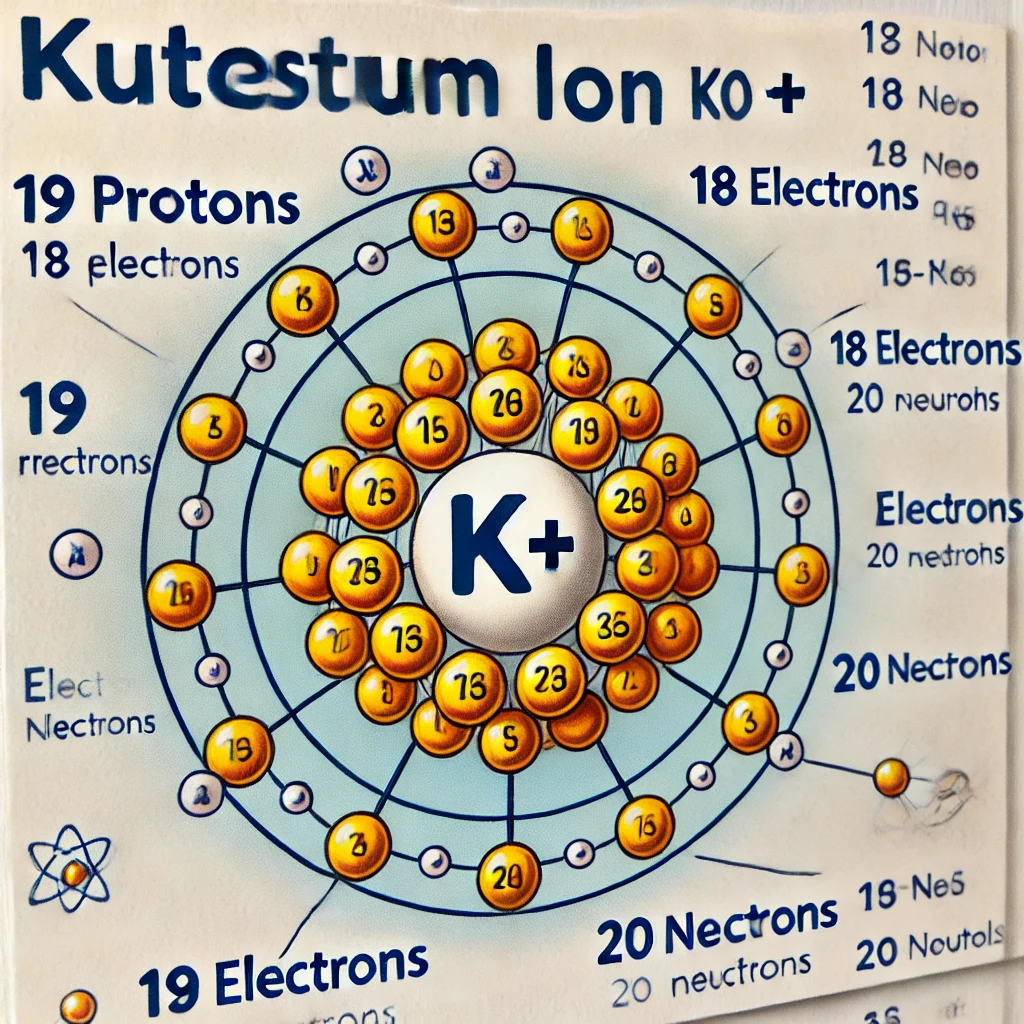
Here is the diagram illustrating the structure of a potassium ion ( K^+ ), showing 19 protons, 18 electrons, and 20 neutrons. This should help you visualize the atomic configuration.