Compared to a perfectly competitive firm, the demand curve facing a monopolistically competitive firm is
A) more elastic because there are many close substitutes for the product of a monopolistically competitive firm.
B) less elastic because monopolistically competitive firms produce similar, but not identical, products.
C) just as elastic because there are many sellers in both markets.
D) more elastic because in the long run, the demand curve is tangent to the firm's average total cost curve.
The correct answer and explanation is :
Correct Answer:
B) Less elastic because monopolistically competitive firms produce similar, but not identical, products.
Explanation:
A monopolistically competitive firm faces a downward-sloping demand curve that is less elastic than that of a perfectly competitive firm but more elastic than that of a monopoly. The key reason for this is product differentiation—each firm in a monopolistically competitive market produces a product that is slightly different from those of its competitors.
1. Comparison with Perfect Competition
In perfect competition, individual firms are price takers, meaning their demand curve is perfectly elastic (horizontal) because identical products are sold by many firms. Consumers can switch to another firm with no cost if a single firm raises its price.
However, in monopolistic competition, firms sell products that are similar but not identical (e.g., different brands of toothpaste, coffee, or clothing). This differentiation gives firms some degree of pricing power, making the demand curve less elastic than in perfect competition.
2. Elasticity and Product Differentiation
Since consumers may have brand preferences or perceive differences in quality, they are not perfectly willing to switch to another firm’s product simply due to a price change. This makes demand less responsive (i.e., less elastic) to price changes than in perfect competition.
3. Why Not Other Options?
- Option A is incorrect because while there are substitutes, they are not perfect substitutes, reducing elasticity.
- Option C is incorrect because perfect competition has a perfectly elastic demand curve, unlike monopolistic competition.
- Option D is incorrect because long-run equilibrium does not directly make demand more elastic.
Thus, the correct answer is B: less elastic due to product differentiation.
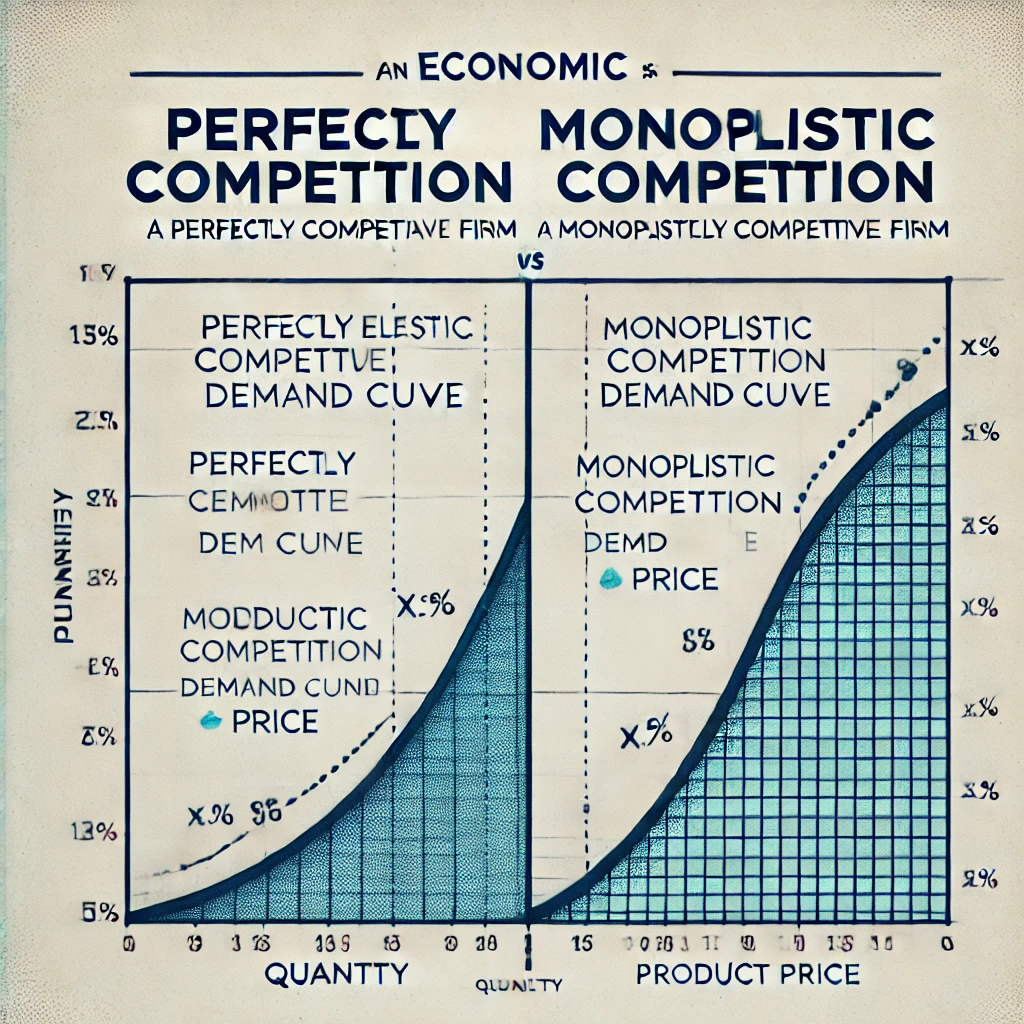
Here is an image illustrating the difference between the demand curves of a perfectly competitive firm and a monopolistically competitive firm.