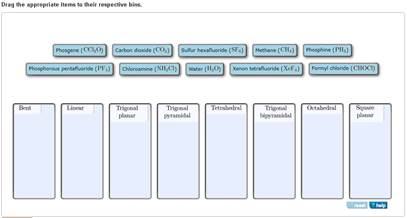
Drag the appropriate items to their respective bins.
The correct answer and explanation is:
iturn0image0turn0image1turn0image3turn0image10Based on the provided image, the task involves classifying various intermediates of glycolysis into two categories: those that occur in the first half of the pathway (energy investment phase) and those in the second half (energy payoff phase). Here’s the correct classification:
Intermediates in the First Half of Glycolysis (Energy Investment Phase):
- Fructose-6-phosphate
- Fructose-1,6-bisphosphate
- Glucose-6-phosphate
- Glucose
Intermediates in the Second Half of Glycolysis (Energy Payoff Phase):
- 3-Phosphoglycerate
- 2-Phosphoglycerate
- Phosphoenolpyruvate
- Pyruvate
Explanation:
Glycolysis is a fundamental metabolic pathway that breaks down glucose into pyruvate, yielding energy in the form of ATP and NADH. This pathway consists of ten enzymatic reactions divided into two main phases:
- Energy Investment Phase (First Half):
- In this phase, the cell invests ATP to initiate the breakdown of glucose.
- The steps include:
- Glucose is phosphorylated by hexokinase to form glucose-6-phosphate.
- Glucose-6-phosphate is isomerized to fructose-6-phosphate by phosphoglucose isomerase.
- Fructose-6-phosphate is further phosphorylated by phosphofructokinase to produce fructose-1,6-bisphosphate.
- These reactions consume ATP and prepare the glucose molecule for subsequent cleavage.
- Energy Payoff Phase (Second Half):
- This phase generates ATP and NADH by further processing the products of the first phase.
- The steps include:
- Fructose-1,6-bisphosphate is split into two three-carbon molecules, which are then converted into 3-phosphoglycerate.
- 3-Phosphoglycerate is converted to 2-phosphoglycerate by phosphoglycerate mutase.
- 2-Phosphoglycerate is dehydrated by enolase to form phosphoenolpyruvate (PEP).
- PEP is then converted to pyruvate by pyruvate kinase, producing ATP in the process.
Understanding the specific intermediates and their placement within the glycolytic pathway is crucial for comprehending how cells harvest energy from glucose. This knowledge is foundational in biochemistry and essential for fields like medicine and physiology, where energy metabolism plays a pivotal role in health and disease.