Give Lewis dot structures and shapes for the following:
a. VOCI3
b. PCI3
c. SOF4
d. SO3
e. ICI3
f. SF6
g. IF7
h. XeO2F4
i. CF2CI2
j. P4O6
(P4O6, is a closed structure with overall tetrahedral arrangement of phosphorus atoms, an oxygen atom bridges each pair of phosphorus atoms.)
The correct answer and explanation is :
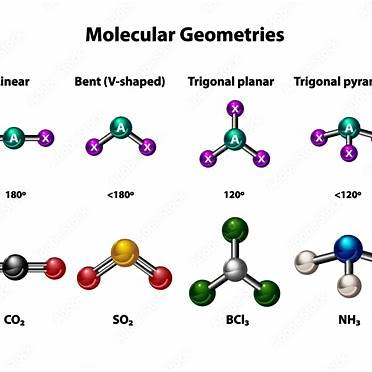
Understanding the Lewis dot structures and molecular geometries of various compounds is essential in predicting their chemical behavior and properties. Below are the Lewis structures and shapes for the specified compounds:
a. VOCl₃ (Vanadium Oxytrichloride)
- Lewis Structure: Vanadium (V) is the central atom bonded to one oxygen (O) atom and three chlorine (Cl) atoms. The oxygen atom forms a double bond with vanadium, while each chlorine atom forms a single bond.
- Shape: The molecule adopts a tetrahedral geometry due to four regions of electron density around the central vanadium atom.
b. PCl₃ (Phosphorus Trichloride)
- Lewis Structure: Phosphorus (P) is the central atom with three single bonds to chlorine (Cl) atoms and one lone pair of electrons.
- Shape: The presence of the lone pair results in a trigonal pyramidal molecular geometry.
c. SOF₄ (Thionyl Tetrafluoride)
- Lewis Structure: Sulfur (S) is the central atom bonded to one oxygen (O) atom (double bond) and four fluorine (F) atoms (single bonds).
- Shape: With five regions of electron density, the molecule exhibits a trigonal bipyramidal geometry.
d. SO₃ (Sulfur Trioxide)
- Lewis Structure: Sulfur (S) is centrally bonded to three oxygen (O) atoms, each via double bonds.
- Shape: The molecule is planar with a trigonal planar geometry.
e. ICl₃ (Iodine Trichloride)
- Lewis Structure: Iodine (I) is the central atom with three single bonds to chlorine (Cl) atoms and two lone pairs of electrons.
- Shape: The molecule has a T-shaped geometry due to the influence of the lone pairs.
f. SF₆ (Sulfur Hexafluoride)
- Lewis Structure: Sulfur (S) is centrally bonded to six fluorine (F) atoms, each via single bonds.
- Shape: The molecule adopts an octahedral geometry.
g. IF₇ (Iodine Heptafluoride)
- Lewis Structure: Iodine (I) is the central atom bonded to seven fluorine (F) atoms with single bonds.
- Shape: The molecule exhibits a pentagonal bipyramidal geometry.
h. XeO₂F₄ (Xenon Dioxide Tetrafluoride)
- Lewis Structure: Xenon (Xe) is the central atom bonded to two oxygen (O) atoms (double bonds) and four fluorine (F) atoms (single bonds).
- Shape: The molecule has an octahedral electron geometry, but the molecular shape is square planar due to the positions of the oxygen atoms.
i. CF₂Cl₂ (Dichlorodifluoromethane)
- Lewis Structure: Carbon (C) is the central atom bonded to two fluorine (F) atoms and two chlorine (Cl) atoms, all via single bonds.
- Shape: The molecule exhibits a tetrahedral geometry.
j. P₄O₆ (Tetraphosphorus Hexoxide)
- Lewis Structure and Shape: This molecule consists of four phosphorus (P) atoms arranged in a tetrahedral structure, with each edge of the tetrahedron bridged by an oxygen (O) atom. Each phosphorus atom is bonded to three oxygen atoms, forming a cage-like structure.
Understanding these structures and geometries is crucial for predicting reactivity, polarity, and interactions with other molecules.