If the atomic radius of a copper atom is 1.28 x 10⁻⁸ cm, how many atoms thick is the copper coating on your penny?
The correct answer and explanation is :
To determine how many atoms thick the copper coating on a penny is, we need to use the given atomic radius of copper and an estimated thickness of the copper layer.
Given:
- Atomic radius of copper: ( 1.28 \times 10^{-8} ) cm
- Diameter of a copper atom (which represents the approximate thickness of one atomic layer):
[
d = 2 \times \text{radius} = 2 \times (1.28 \times 10^{-8} \text{ cm})
]
[
d = 2.56 \times 10^{-8} \text{ cm}
] - Estimated thickness of copper coating on a penny: ( 3.0 \times 10^{-3} ) cm
Calculation:
To find how many atoms thick the coating is, divide the total thickness by the diameter of a single atom:
[
\frac{\text{Thickness of copper coating}}{\text{Diameter of a copper atom}} = \frac{3.0 \times 10^{-3} \text{ cm}}{2.56 \times 10^{-8} \text{ cm}}
]
[
= 1.17 \times 10^5 \text{ atoms}
]
Answer:
The copper coating on a penny is approximately 117,000 atoms thick.
Explanation:
A U.S. penny is coated with a thin layer of copper, while its inner core is mostly zinc. The atomic radius of a copper atom is extremely small, meaning that even a seemingly thin copper layer consists of many atoms stacked together. By dividing the estimated thickness of the copper coating by the atomic diameter of a single copper atom, we can determine the number of atoms forming the layer. This calculation helps illustrate the nanoscale nature of atomic structures and how incredibly small atoms are compared to everyday objects.
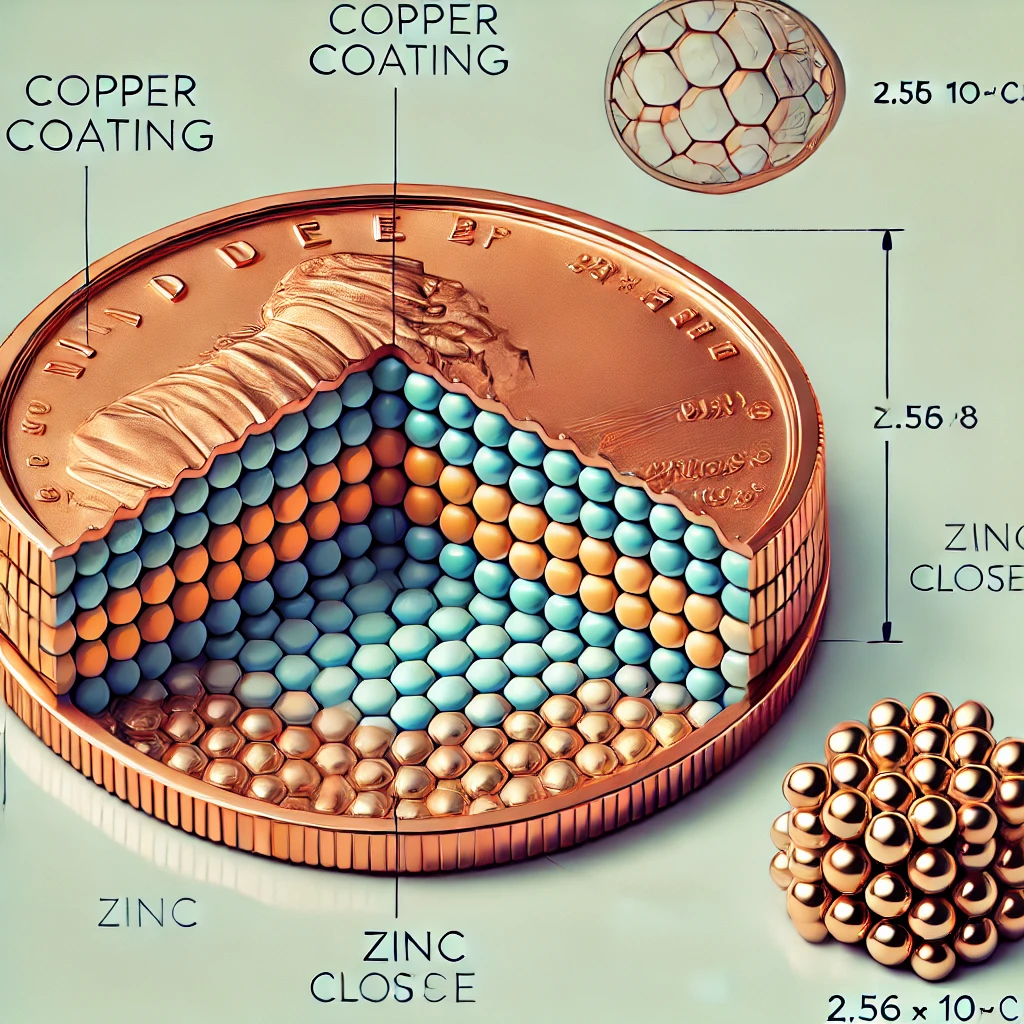
Here is an illustration showing the thickness of the copper coating on a penny at the atomic scale. It includes a zoomed-in cross-section with labeled layers and a magnified view of individual copper atoms.