In contrast with perfect competition, excess capacity characterizes monopolistic competition. Excess capacity is due to which of the following?
A) Monopolistically competitive firms produce at the minimum point on their average total cost curves.
B) Monopolistically competitive firms face downward-sloping demand curves. In the long run, firms produce where their demand curves are tangent to their long-run average total cost curves.
C) Monopolistically competitive firms produce where marginal revenue is equal to marginal cost.
D) Monopolistically competitive markets have low barriers to entry.
The correct answer and explanation is :
The correct answer is:
B) Monopolistically competitive firms face downward-sloping demand curves. In the long run, firms produce where their demand curves are tangent to their long-run average total cost curves.
Explanation:
Excess capacity in monopolistic competition arises because firms do not produce at the minimum point on their average total cost (ATC) curve. Instead, they produce at a level where the demand curve is tangent to the ATC curve in the long run. This occurs due to the downward-sloping nature of the demand curve faced by firms in monopolistic competition.
Unlike perfect competition, where firms are price takers and produce at the minimum ATC to maximize efficiency, monopolistically competitive firms differentiate their products. This differentiation gives them some degree of market power, meaning they face a downward-sloping demand curve rather than a perfectly elastic one.
In the long run, as new firms enter the market due to low barriers to entry, the demand curve for each firm shifts leftward, reducing its market share and profit until economic profits are zero. At this point, firms produce where their demand curve is tangent to their ATC curve, but not at the minimum ATC. As a result, firms operate with excess capacity, meaning they could produce more output at a lower cost per unit but do not do so because increasing output would require lowering the price, reducing profitability.
This inefficiency contrasts with perfect competition, where firms produce at the most efficient scale. In monopolistic competition, firms choose differentiation over efficiency, leading to excess capacity as a trade-off for product variety.
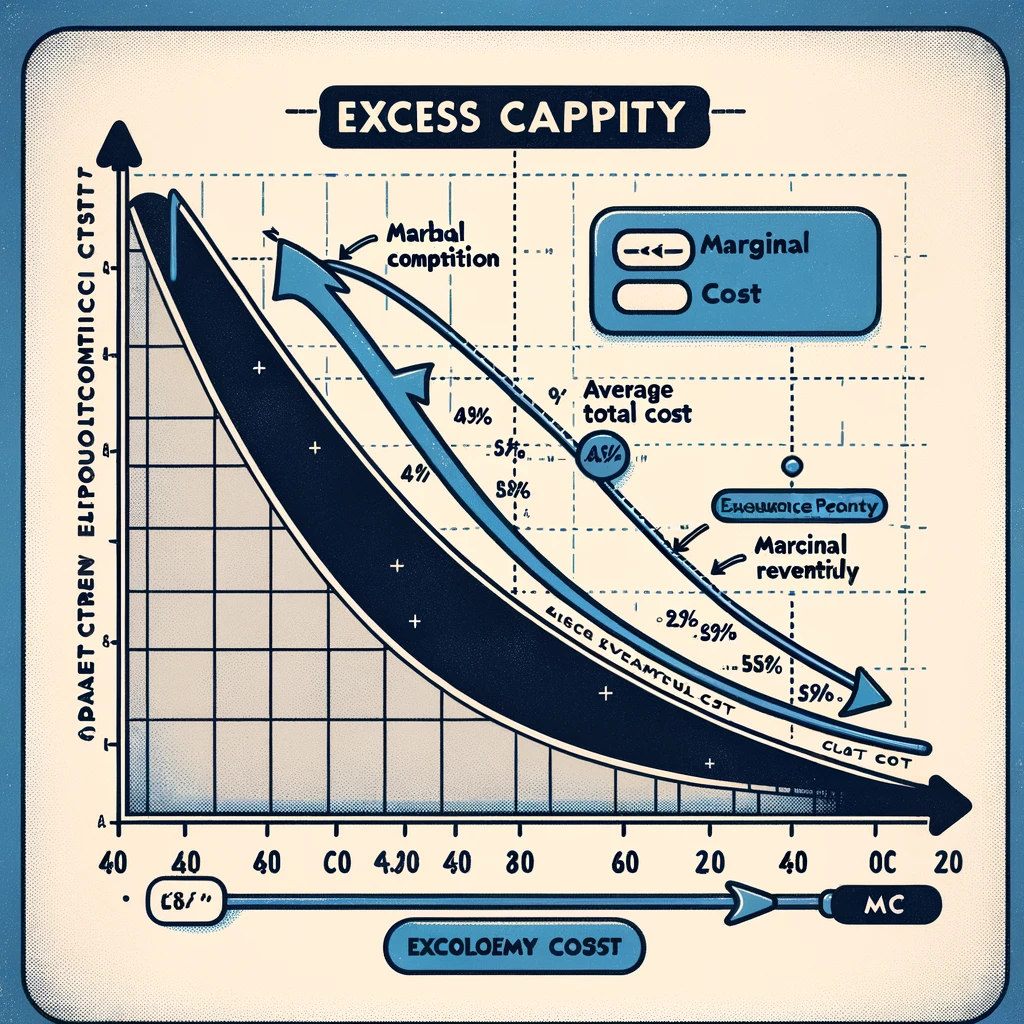
Here is an economic graph illustrating excess capacity in monopolistic competition. It highlights how firms produce at a point where the demand curve is tangent to the average total cost (ATC) curve but not at its minimum, leading to excess capacity.